

 Ashish Sharma
Creational design patterns help developers handle object creation cleanly. Instead of scattering the new keyword throughout your application, these patterns centralize your instantiation logic. Two of the most common creational patterns are the Factory Method Pattern and the Abstract Factory Pattern.
While they sound incredibly similar, they serve entirely different structural purposes. This article breaks down their core differences, architectural layouts, real-world use cases, and code implementations.
What is the Factory Design Pattern?
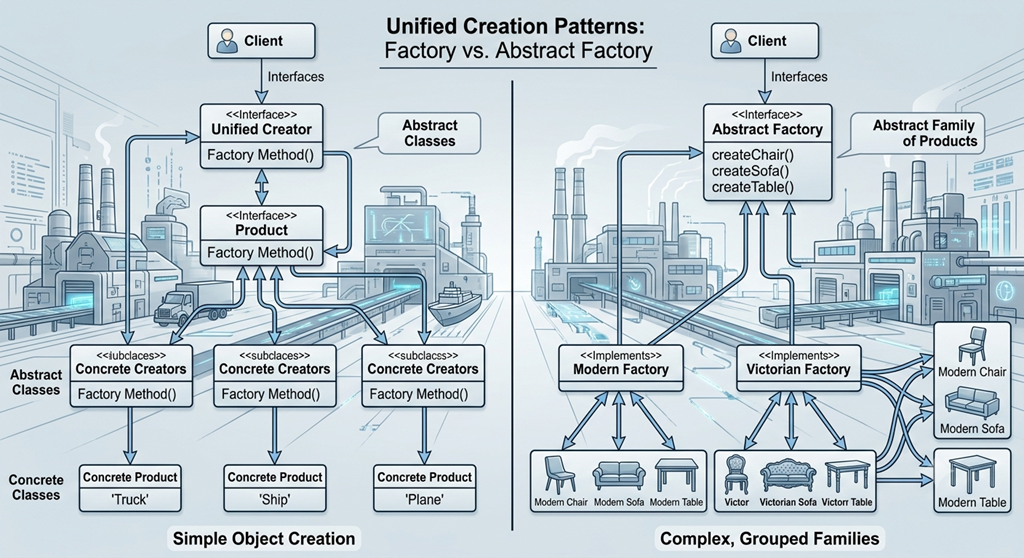
The Factory Method pattern defines an interface or an abstract class for creating a single object, but it lets subclasses decide which specific class to instantiate. Consequently, it relies heavily on inheritance to delegate the creation process to subclass factories.
Real-World Analogy & Use Case
Imagine a logistics company. If your application initially only handles truck transport, your code directly instantiates Truck objects. However, when you suddenly need to add maritime transport, your code breaks. By implementing a Factory pattern, you create a generic TransportFactory that delivers either a Truck or a Ship based on the input parameters.
    Client --> Factory --> Product (Interface)
                          |--> ConcreteProductA
                          |--> ConcreteProductB
Example:
// Product interface
interface Shape {
    void draw();
}

// Concrete products
class Circle implements Shape {
    public void draw() { System.out.println("Drawing Circle"); }
}

class Square implements Shape {
    public void draw() { System.out.println("Drawing Square"); }
}

// Factory
class ShapeFactory {
    public Shape getShape(String type) {
        if ("CIRCLE".equalsIgnoreCase(type)) return new Circle();
        if ("SQUARE".equalsIgnoreCase(type)) return new Square();
        return null;
    }
}

// Usage
public class FactoryDemo {
    public static void main(String[] args) {
        ShapeFactory factory = new ShapeFactory();
        Shape shape = factory.getShape("CIRCLE");
        shape.draw();
    }
}
What is the Abstract Factory Design Pattern?
The Abstract Factory pattern provides an interface for creating families of related or dependent objects without specifying their concrete classes. Instead of managing a single product type, it serves as a “factory of factories.” It shifts the responsibility from inheritance to object composition.
Real-World Analogy & Use Case
Consider an application that sells furniture. You have families of related products: ModernChair + ModernSofa or VictorianChair + VictorianSofa. If you mix a modern chair with a Victorian sofa, the design looks inconsistent. An Abstract Factory ensures that your application creates matching product suites seamlessly.
    Client --> AbstractFactory
              |--> ConcreteFactoryA --> ProductA1, ProductA2
              |--> ConcreteFactoryB --> ProductB1, ProductB2
Example
interface Button { void render(); }
interface Checkbox { void render(); }

class WindowsButton implements Button { public void render() { System.out.println("Windows Button"); } }
class WindowsCheckbox implements Checkbox { public void render() { System.out.println("Windows Checkbox"); } }

class MacButton implements Button { public void render() { System.out.println("Mac Button"); } }
class MacCheckbox implements Checkbox { public void render() { System.out.println("Mac Checkbox"); } }

interface GUIFactory {
    Button createButton();
    Checkbox createCheckbox();
}

class WindowsFactory implements GUIFactory {
    public Button createButton() { return new WindowsButton(); }
    public Checkbox createCheckbox() { return new WindowsCheckbox(); }
}

class MacFactory implements GUIFactory {
    public Button createButton() { return new MacButton(); }
    public Checkbox createCheckbox() { return new MacCheckbox(); }
}

public class Demo {
    public static void main(String[] args) {
        GUIFactory factory = new WindowsFactory();
        factory.createButton().render();
        factory.createCheckbox().render();
    }
}
Core Technical Differences
| Feature | Factory Method | Abstract Factory |
| Primary Focus | Creates a single product variant. | Creates a family of related products. |
| Mechanism | Relies on inheritance (subclasses override a method). | Relies on composition (factory object contains creation methods). |
| Complexity | Low; requires one creator class and a few product variants. | High; requires multiple interfaces, concrete factories, and product matrices. |
| Adding a Product | Straightforward; you just add a new subclass or conditional check. | Hard; changing the factory interface requires altering all concrete factories. |
Summary: When Should You Use Which?
Choosing the right pattern keeps your codebase flexible and clean.
- Choose the Factory Method Pattern if your code only needs to create one type of product, and you want to separate the object creation logic from the primary consumer class.
- Choose the Abstract Factory Pattern if your system needs to manage multiple, interdependent families of products, and you want to ensure that those products always match visually or functionally.
Drawbacks
- Factory: Harder to extend without modifying factory logic.
- Abstract Factory: Higher complexity and more boilerplate.