

 Ashish Sharma
Have you ever unboxed a brand-new, $1,200 flagship smartphone, only to feel like it belongs in a museum just twelve months later? According to research, this common consumer experience is known as the “Billion-Dollar Heartbreak.” Although it feels like an accident, smartphone manufacturers intentionally build this dynamic into the tech ecosystem.
If you want to understand how tech companies keep you upgrading, you must look closely at how they price their hardware, manage their software, and manipulate consumer psychology.
Breaking Down the Real Cost of Your Phone
When you purchase a flagship device on launch day, you pay far more than the cost of the physical technology. In fact, your investment splits into three distinct buckets:
- The Physical Hardware: This includes the raw cost of parts like the display, camera sensors, processors, and assembly labor.
- The Intangibles: Your money funds deep research and development (R&D) for new artificial intelligence (AI) features, alongside massive global advertising campaigns.
- The “Premium Tax”: This is a literal “show-off” fee. You pay a premium simply to be among the first people to own the latest gadget.
Consequently, if you want to know the true market value of the hardware, look at its retail price two years after release. By that time, the marketing hype completely evaporates, leaving behind only the actual value of the machine.
Planned Obsolescence: The Sneaky Software Shuffle
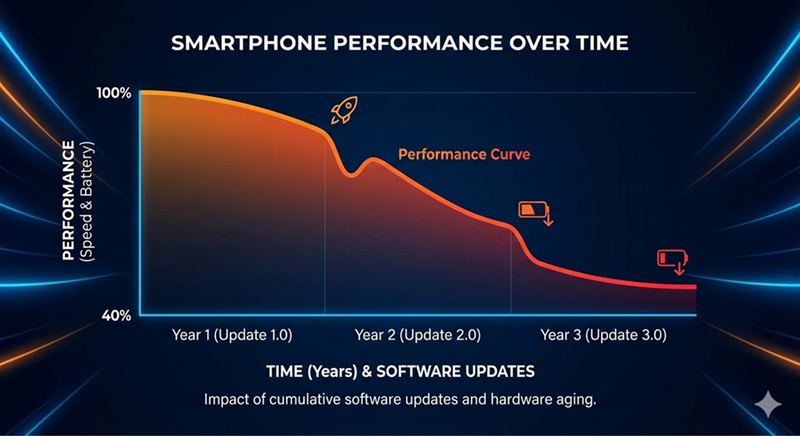
Many users notice that their once-blazing-fast flagship begins to stutter and lag right around the time the company announces a new model. Research proves this is not just a trick of your imagination. Instead, manufacturers actively practice planned obsolescence through a process called “The Operating System Shuffle.”
First, developers optimize the latest operating system updates specifically for their newest silicon chips. When you download these heavy updates onto a phone that is even one generation old, the bloated software consumes significantly more RAM and battery power. As a result, your snappy phone suddenly feels heavy and sluggish.
Furthermore, historical cases reveal that major tech giants have purposefully throttled central processing unit (CPU) speeds under the guise of “protecting aging batteries.” Naturally, this reduction in performance pushes frustrated users directly toward the trade-in counter.
The Psychological Trap of Digital Caste Systems
Modern smartphone marketing no longer focuses on selling practical tools. Instead, brands sell social relevance. They utilize powerful “Fear of Missing Out” (FOMO) tactics to make you believe you are actively falling behind your peers.
For instance, advertising campaigns frame the latest AI filters or advanced camera lenses as necessities for daily productivity or creativity. To make matters worse, companies create an artificial digital caste system. They frequently lock software features—which could easily run on older hardware—exclusively to the newest models to make your current device feel inferior.
Beat the System with the “n-minus-1” Rule
Fortunately, you can escape this consumer cycle entirely by changing how you shop. Unless you review technology for a living, purchasing a flagship device on launch day rarely makes financial sense. The technological leaps between subsequent phone generations are now so marginal that you will barely notice them during daily tasks like texting, scrolling, or streaming.
Therefore, you should adopt the “n-minus-1” rule. Instead of chasing the latest release, buy the previous generation’s flagship model or wait for the new model’s first major price drop. By using this strategy, you secure 90% of the premium user experience for roughly 50% of the retail cost. Ultimately, you keep your hard-earned money and completely bypass the flagship trap.