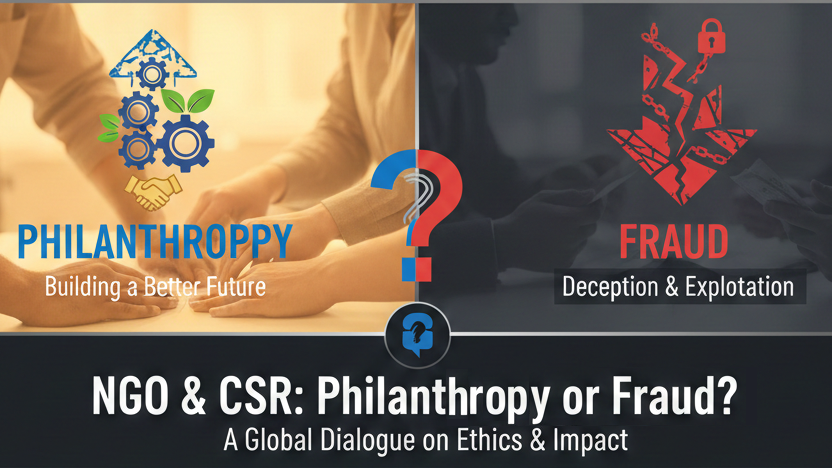
NGO and CSR: Philanthropy or Fraud?
For decades, the concept of giving was simple: those who had plenty helped those who had little. Today, that simplicity has been replaced by a complex, multi-billion dollar industry where the lines between “non-profit” and “high-profit” are increasingly blurred. While the intention behind NGOs and Corporate Social Responsibility (CSR) is noble, a growing “philanthro-cynicism” suggests that these systems have evolved into legal machines used for tax evasion, money laundering, and maintaining elite lifestyles—a shadow economy.
The NGO Loophole: From Grassroots to “Black-to-White” Pipelines
While the majority of NGOs perform life-saving work, the sector’s lack of rigorous, real-time oversight has made it a playground for financial engineering.
The suspicion that NGOs are used for money laundering isn’t just a theory; it’s a documented challenge for regulators. In countries like India, the Prevention of Money Laundering Act (PMLA) and the Foreign Contribution Regulation Act (FCRA) have been tightened specifically because of these loopholes.
- Shell NGOs: Fictitious organizations created solely to receive “donations” that are actually black money. These funds are later returned to the donor as “clean” money via fake consultancy fees or vendor payments.
- The Round-Tripping Effect: In many jurisdictions, a donation provides a 50% to 100% tax deduction. By donating illicit cash and receiving a portion back in white money, the donor effectively “washes” their capital while reducing their tax liability.
The Scale of the Crackdown
Governments have begun to wake up to this reality. In India alone, the government cancelled the Foreign Contribution Regulation Act (FCRA) licenses of over 20,000 NGOs in recent years due to non-compliance and suspicious financial flows. Globally, the Financial Action Task Force (FATF) now categorizes the non-profit sector as “vulnerable” to terrorist financing and money laundering.
The Lifestyle of “Luxury Activism”
One of the most jarring sights for a middle-class donor is the “Executive Activist.” There is a profound disconnect when a representative from a multi-million dollar NGO asks a salaried worker for a small donation while the organization’s leadership enjoys:
- Business Class Travel: Justified as “necessary for global advocacy.”
- Seven-Figure Salaries: CEOs of large international NGOs often earn upwards of $500,000 annually.
This is often a result of Administrative Overheads.
- The 20% Rule: Traditionally, it was considered standard for NGOs to keep administrative costs (salaries, travel, offices) under 20%. However, in large international NGOs, high executive salaries are defended as “attracting top talent” to manage complex global operations.
- The Perception Gap: When a CEO of a non-profit earns upwards of $500,000 annually (common in large US-based non-profits), the line between a “mission-driven leader” and a “corporate executive” blurs, leading to the “guilt-trip” marketing strategies that feel predatory to the average donor.
The Religious “Tax Shield”
Religious trusts often enjoy the broadest tax exemptions. Because “religious purpose” is broadly defined, these organizations can accumulate massive wealth with minimal oversight compared to secular NGOs.
| Feature | Secular NGO | Religious Trust (e.g., India/US) |
| Tax Status | Strictly audited for “charitable” use. | Often automatically exempt. |
| Transparency | High filing requirements (Form 990/ITR-7). | Often exempt from detailed public disclosure. |
| Wealth Accumulation | Limited by specific project goals. | Can accumulate vast land and gold reserves as “corpus.” |
In the U.S., churches are exempt from filing Form 990, meaning the public has zero visibility into how much their leaders are paid or how donations are actually spent. In India, while the “85% Rule” requires trusts to spend most of their income, the definition of “religious purpose” is broad enough to allow for significant capital accumulation and lifestyle funding for “Godmen.”
CSR: Mandatory Goodness or Legalized Laundering?
India’s landmark Section 135 of the Companies Act (2013) made it the first country to mandate CSR (2% of net profits). While this generates roughly ₹30,000 crore annually, critics argue it has simply institutionalized the “black-to-white” machine.
The “In-House” Foundation Trap
Large corporations often create their own non-profits. While legal, this allows the company to keep the CSR funds “in-house,” paying salaries to their own board members and building brand equity rather than solving grassroots issues. This allows the company to:
- Retain Control: The money stays within the corporate ecosystem.
- Branding: Use “charity” money for what is essentially a marketing campaign.
- Executive Perks: Use the foundation to pay salaries to family members or board associates.
The Numbers and the Reality
Companies with a net worth of ₹500 crore or more, or a net profit of ₹5 crore or more, must spend 2% of their average net profits on CSR.
| Metric | Impact | The “Loophole” |
| Total Spend | Over ₹1.2 trillion has been spent since 2014. | Much of this is “channelled” into the company’s own foundations |
| Project Focus | Education and Healthcare receive ~60% of funds. | Rural areas are often neglected for “prestige projects” in cities. |
| The “Kickback” | Direct aid to the needy. | Companies may hire “friendly” NGOs to fulfill the 2% quota, who then spend that money back on the company’s interests |
The Evolution of the “Big Name” NGO
There is a tragic lifecycle to many organizations. They begin with genuine passion and lean operations. However, as they become “Big Names,” the mission often shifts from solving the problem to sustaining the institution.
When an NGO becomes too large to fail, its primary goal becomes fundraising to cover its own massive payroll and office leases in expensive capital cities. This leads to the “Band-Aid” approach: keeping a problem visible enough to solicit donations, but never actually solving the root cause, as doing so would render the NGO—and its executive salaries—obsolete.
You noted that many start with good intentions but change once they become “big names.” This is often referred to as Institutionalization.
- Stage 1: Grassroots passion, low overhead, direct impact.
- Stage 2: Growth requires fundraising, which requires marketing, which requires “salespeople” and high-end offices to impress “big donors.”
- Stage 3: The survival of the organization (and its high salaries) becomes the priority, sometimes surpassing the mission itself.
Conclusion: Toward Hopeful Skepticism
The current system is a hybrid of genuine aid and systemic exploitation. While CSR and NGOs have provided education and healthcare to millions, the “legal machine” that facilitates money laundering and luxury activism cannot be ignored.
True reform requires real-time digital auditing, a cap on executive compensation relative to median worker pay, and the removal of “automatic” tax exemptions for religious entities that function like corporations. Until then, the middle-class donor is right to be skeptical.













Post Comment