
 Ashish Sharma
No money? No problem! Help us pay the cloud hosting bills without opening your wallet—just give
this ad link a click!😉💸
Every time you search for a topic online, check your social media feed, or stream a video, you rely on a fundamental architectural pattern: the client-server model. This core concept powers everything from simple websites and mobile applications to massive distributed systems and cloud APIs.
If you want to build scalable, reliable software, you must understand how clients and servers interact. This article breaks down the client-server model in simple terms, covering its core components, communication styles, real-world use cases, and key interview questions.
What is the Client-Server Model?
The client-server model is a distributed computing structure that divides tasks or workloads between two main entities: service providers (servers) and service requesters (clients).
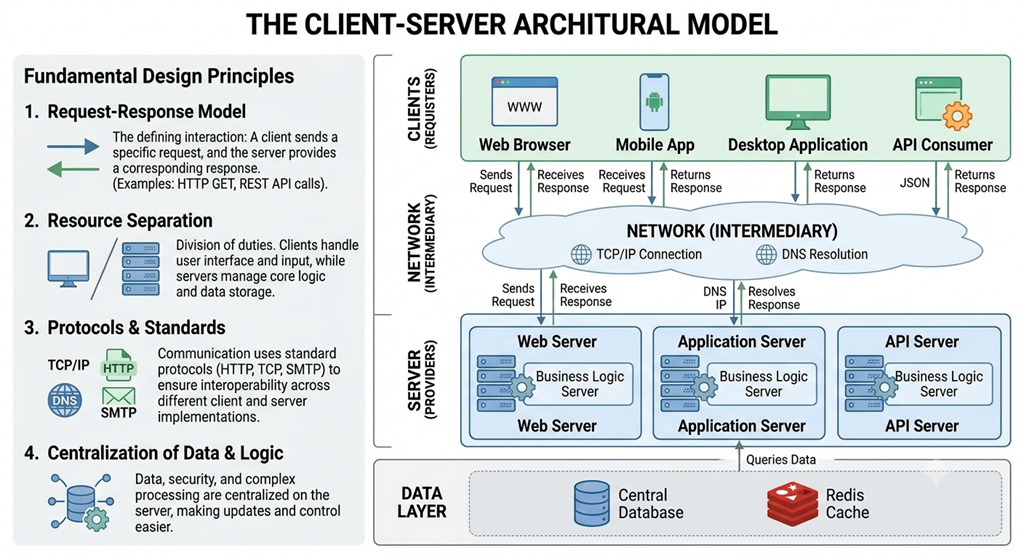
At its heart, this model thrives on the separation of responsibilities:
- The Client handles the user interface and presentation layer.
- The Server manages the heavy lifting, including data storage, business logic, and security rules.
By separating these duties, engineers can scale, secure, and maintain systems independently as user demand grows.
Key Components of the Architecture
Every client-server interaction relies on three essential components working together smoothly:
- The Client: The user-facing entry point into the system. This can be a web browser (like Chrome or Safari), a mobile app, or another backend service consuming an API. The client collects user inputs, sends requests, and displays responses cleanly.
- The Server: The centralized powerhouse. It listens for incoming network requests, processes business logic, communicates with databases, and returns the requested data.
- The Network: The bridge connecting both sides. While engineers focus heavily on coding the client and server, real-world systems must handle network imperfections like latency, bandwidth limits, and packet loss.
How Clients and Servers Communicate
The Traditional Request-Response Model
The most common communication pattern is the request-response cycle. A client sends an explicit request, the server processes it, sends back a response, and the connection closes. This setup is highly efficient and stateless, making it the perfect choice for standard web pages and REST APIs.
Persistent Connections (WebSockets)
For applications that require instant updates—such as live chat, multiplayer gaming, or stock trading—opening a new connection for every interaction creates too much overhead. Instead, WebSockets maintain an open, bidirectional communication channel, allowing both sides to push data instantly without waiting for a new request.
Real-World Use Cases and Scenarios
The client-server model adapts perfectly to different application styles. Here is how we use it today:
| Use Case | Client Role | Server Role | Communication Style |
| Web Browsing | Web Browser (Chrome, Firefox) | Web Server (Nginx, Apache) | Request-Response (HTTP) |
| Mobile APIs | iOS/Android App | Microservice Backend | Synchronous REST/GraphQL |
| Database Queries | Backend Application Server | Database Server (PostgreSQL, MySQL) | Persistent TCP Connections |
| Real-time Chat | Messaging App UI | Chat Server (Node.js/Go) | Bidirectional (WebSockets) |
Architectural Insight: A single component can play both roles. For example, a backend application acts as a server to a mobile app client, but transforms into a client when it requests data from a database server.
Key Design Trade-offs for System Architects
When designing an enterprise system, you must make crucial architectural decisions that alter system behavior:
Synchronous vs. Asynchronous Communication
Synchronous: The client sends a request and freezes, waiting for the server to answer. This is simple and predictable, ideal for user login or payment processing.
Asynchronous: The client sends a request and immediately returns to its work. The server processes the job in the background and alerts the client later via event queues or webhooks. This maximizes system responsiveness and scaling.
Stateless vs. Stateful Servers
Stateless Servers: Every single request stands completely alone. The server does not store user session data locally. This makes horizontal scaling a breeze, because a load balancer can route traffic to any healthy server instance.
Stateful Servers: The server remembers previous interactions and retains client context. While wonderful for continuous real-time gaming or collaborative document editing, it makes server failovers and load balancing significantly more complex.
Client-Server Model: High-Frequency Interview Q&A
Q1: Walk me through the exact steps of how a browser loads a webpage.
- DNS Resolution: The browser takes the human-friendly URL (e.g.,
example.com) and queries a Domain Name System (DNS) server to find its actual IP address. - TCP Handshake: The browser establishes a connection with the server at that IP address.
- HTTP Request: The browser sends an HTTP GET request asking for the web page content.
- Server Processing: The web server fetches the HTML files, accesses databases or caches if needed, and builds the response payload.
- HTTP Response: The server returns the assets alongside an HTTP status code (like
200 OK). - Rendering: The browser parses the HTML, handles layouts, and triggers subsequent requests for CSS, images, and JavaScript files.
Q2: How do load balancers and caching improve client-server performance?
- Load Balancers sit in front of your servers and distribute incoming client requests evenly across multiple machines. This eliminates single points of failure and prevents any single server from becoming overwhelmed.
- Caching stores frequently requested data closer to the user (in the browser cache, a CDN, or an in-memory database like Redis). This bypasses repetitive, expensive database queries and slashes server latency.
Q3: What are the main security challenges in this model?
Because data travels across public networks, systems are vulnerable to Man-in-the-Middle (MITM) attacks, which engineers mitigate using HTTPS encryption. Additionally, public-facing servers face DDoS attacks (mitigated via rate limiting and CDNs) and data layer exploits like SQL Injection (prevented using parameterized queries).

I like that you start with the separation of responsibilities between the client and the server, because it’sBlog Comment Creation Guide much easier to understand the architecture before diving into scalability. It could also be helpful to mention how this model changes in modern systems with load balancers, caching, or CDNs, since those are common building blocks that people encounter as applications grow.