

 Ashish Sharma
No money? No problem! Help us pay the cloud hosting bills without opening your wallet—just give
this ad link a click!😉💸
When you navigate the web, your data doesn’t always travel in a direct line from your computer to the target website. Instead, it frequently passes through a layer of abstraction known as a proxy server.
A proxy server acts as an intermediary system sitting right between a client (like your browser) and a destination server. When you make a request, the proxy intercepts it, sends it along to the final server, receives the response, and relays it back to you.
While that sounds simple, proxies operate in two distinct directions: Forward Proxies and Reverse Proxies. Understanding how they differ is crucial for building secure, scalable networks.
Visualizing the Architecture
To understand how these systems differ, let’s look at where they sit in a network configuration.
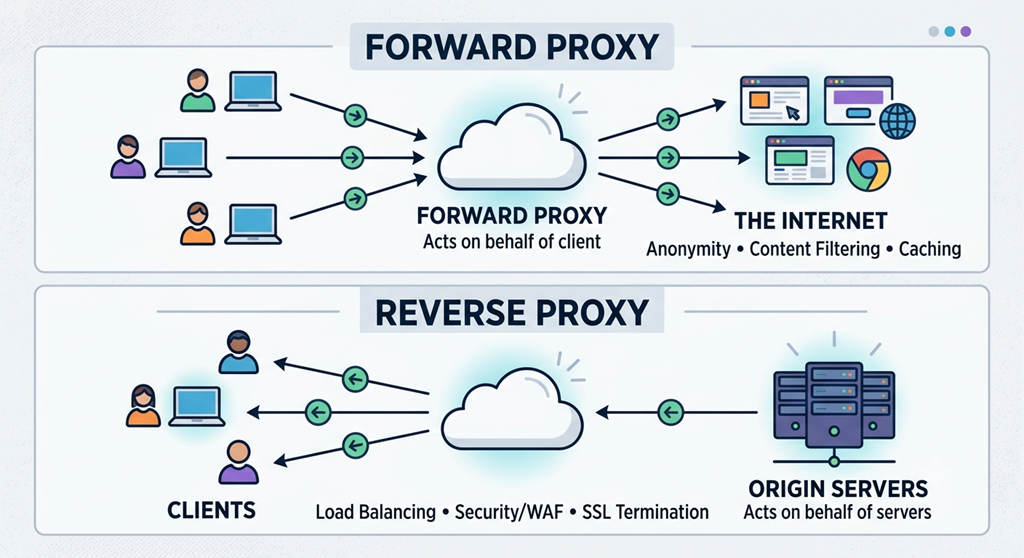
As shown in the diagram, a forward proxy shields the identity of the clients, while a reverse proxy shields the identity of internal resources and backend servers.
The Forward Proxy: The Client’s Shield
A Forward Proxy sits directly between internal clients and the public internet. Because it acts on behalf of the client, the target web server only sees the proxy’s IP address rather than the user’s real one.
Real-World Use Cases & Examples
- Bypassing Geo-Restrictions: If a streaming service restricts content to specific regions, you can route your traffic through a forward proxy located in that country to open up access.
- Anonymous Browsing: Privacy tools mask user identities to keep your digital footprint private.
- Web Caching: By storing copies of frequently accessed webpages locally, the proxy handles recurring requests faster and reduces overall network bandwidth consumption.
- Corporate Content Filtering: Enterprises install forward proxies to monitor internet traffic and block employees from visiting malicious or non-work-related websites.
Common Tools: Virtual Private Networks (VPNs), Tor, Squid Proxy, and Shadowsocks.
The Reverse Proxy: The Server’s Guardian
While a forward proxy handles outbound requests, a Reverse Proxy manages inbound traffic. It sits between the internet and your backend servers. When a user connects to a site, the reverse proxy intercepts the request and safely forwards it to the appropriate backend server.
Real-World Use Cases & Examples
- Load Balancing: The proxy spreads incoming user requests evenly across multiple backend servers. This prevents any single server from crashing due to high traffic.
- DDoS Protection: By serving as the entry point, the proxy absorbs and filters out malicious traffic before it ever touches your core data servers.
- SSL Termination: The reverse proxy decrypts incoming HTTPS traffic itself. Consequently, the backend servers save valuable processing power because they do not have to perform heavy decryption tasks.
- Content Caching: It stores static assets like HTML pages, images, and videos close to the users, which accelerates delivery speeds.
Common Tools: Nginx, HAProxy, Cloudflare CDN, and AWS Elastic Load Balancer (ELB).
Forward Proxy vs. Reverse Proxy: Key Differences
To help choose the right option for your infrastructure, review this direct comparison:
| Feature | Forward Proxy | Reverse Proxy |
| Position | Sits between the client and the internet | Sits between the internet and backend servers |
| Primary Purpose | Client anonymity and access control | Server protection and load balancing |
| Who Uses It? | End-users and enterprise networks | Hosting providers and data centers |
| Main Target | Protects the client’s identity | Protects the backend server configuration |
| Core Example | VPNs and corporate web filters | CDNs and API Gateways |
Summary Cheat Sheet
- Choose a Forward Proxy if you need to protect your privacy, hide your user identity, or manage outbound web access.
- Deploy a Reverse Proxy if you run web servers and need to optimize traffic distribution, ensure high availability, or defend your internal system architecture from cyber threats.


I like how you clearly separated the roles of forward and reverse proxies by focusing on which side of the connection they protect—it makes the distinction much easier to remember. One addition that could help readers is mentioning that many organizations use both together: a forward proxy for controlling outbound client traffic and a reverse proxy for load balancing, SSL termination, and protecting backend services.