

 Ashish Sharma
No money? No problem! Help us pay the cloud hosting bills without opening your wallet—just give
this ad link a click!😉💸
Imagine launching a new web application. In the beginning, everything runs perfectly. Your app lives on a single server, and it handles early users with ease. But what happens when success arrives? As your user base grows, thousands of concurrent requests flood your system. Suddenly, that reliable single server slows to a crawl or crashes entirely.
This scenario is a rite of passage for growing digital platforms. To survive this stage, you must transition from a single-machine setup to a distributed architecture. At the heart of this transformation lies one critical component: the load balancer.
The Danger of the Single-Server Bottleneck
Most applications start their lifecycle on a single server because it is simple and cost-effective. However, relying on one machine introduces two major risks as your traffic grows:
- Capacity Limits: Every physical or virtual server has finite resources (CPU, RAM, storage, and network bandwidth). When traffic spikes, these resources saturate, causing response times to climb and requests to fail.
- Single Point of Failure (SPOF): If your single server experiences a hardware failure, a software crash, or even routine maintenance, your entire application goes offline.
Initially, many developers attempt to solve this through vertical scaling (adding more CPU or RAM to the existing server). While vertical scaling is straightforward, it is ultimately a temporary fix. It delivers diminishing financial returns and does not remove the single point of failure.
Horizontal Scaling Meets the Coordination Challenge
To build a truly reliable system, you must pivot to horizontal scaling—adding more servers to your infrastructure instead of making one server bigger.
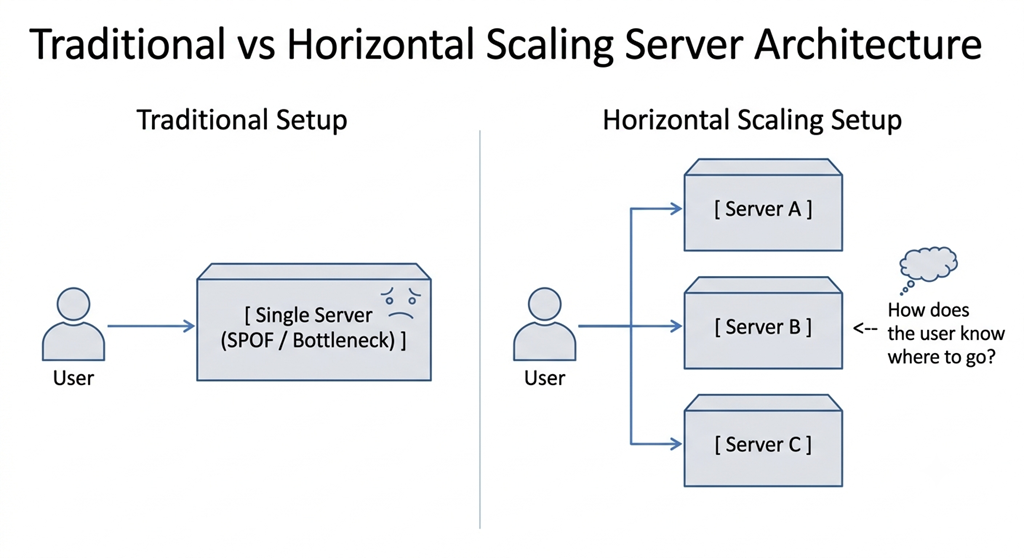
While horizontal scaling increases your total capacity, it immediately introduces a coordination challenge: How do you distribute incoming traffic across these multiple servers?
If clients try to choose which server to connect to, they become tightly coupled to your internal infrastructure. If a server goes offline or a new one is added, every client has to be updated. This coordination challenge is exactly why you need a load balancer.
Introducing the Load Balancer
A load balancer sits as a dedicated, intelligent layer directly in front of your application servers. It acts as a single point of entry for all incoming user traffic.
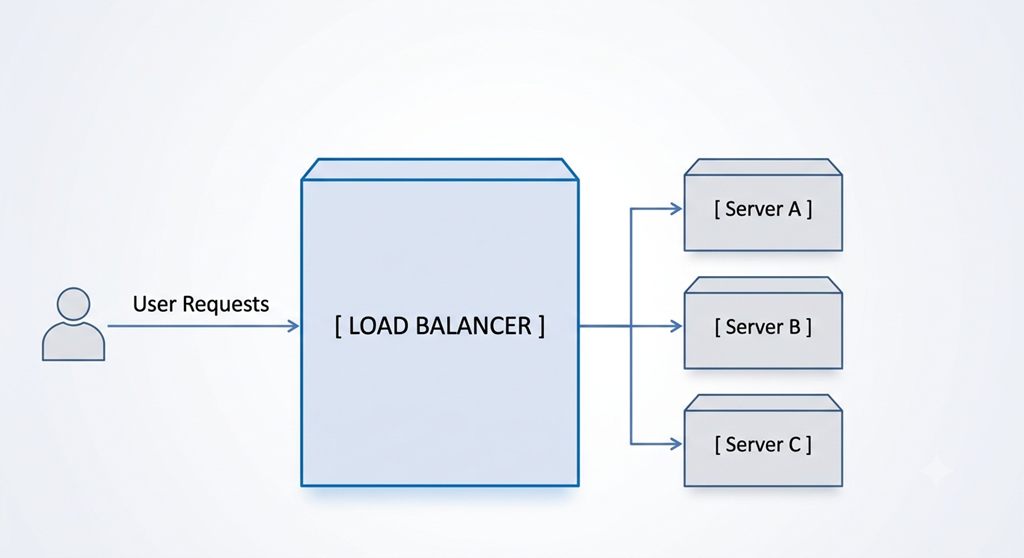
Instead of communicating directly with individual backend servers, users connect to the load balancer. The load balancer then receives the requests and forwards them to the most appropriate, healthy backend server. This architectural shift delivers three immediate benefits:
- A Stable Interface: Clients interact with one stable IP address, while you manage your internal server pool behind the scenes.
- Seamless Scalability: You can add or remove application servers at any time without changing how clients access your app.
- High Availability: The load balancer continuously monitors server health. If Server A crashes, the load balancer instantly stops sending traffic there and redirects it to Server B and Server C.
Key Takeaways: Scaling for the Future
As you design systems for growth, remember that scaling is rarely about buying a larger machine. True reliability comes from smart architecture.
- Decouple your clients from your infrastructure by placing a load balancer at the entry point.
- Embrace horizontal scaling to achieve virtually unlimited capacity.
- Design for failure by using load balancers to isolate and route around broken components.
By transforming a group of independent, fragile servers into a unified, resilient pool, load balancing serves as the bedrock of modern, high-traffic systems.