

 Ashish Sharma
No money? No problem! Help us pay the cloud hosting bills without opening your wallet—just give
this ad link a click!😉💸
When you hear the term System Design, you might immediately picture complex architectural diagrams, massive databases, and clusters of servers. While these components are vital parts of the equation, system design truly focuses on solving real-world business problems through smart technology choices.
Think of system design as creating a comprehensive blueprint for a software system before construction begins. Just as an architect drafts structural plans before workers pour concrete, software engineers must design how components interact before writing lines of code.
What is System Design?
At its core, system design is a decision-making framework. It forces engineers to answer critical architectural questions:
- How will users interact with the application?
- Where will data live securely?
- How will independent services communicate with one another?
- What happens when user traffic abruptly grows ten times larger?
Ultimately, a well-designed system does not just focus on basic functionality. It actively prioritizes scalability, reliability, performance, and maintainability. Furthermore, establishing clear service boundaries reduces overall complexity and allows your software to evolve seamlessly over time.
Why System Design Matters: Beyond the Interview
A common misconception is that system design only matters during technical interviews. In reality, design patterns become increasingly vital as your user base, engineering teams, and operational responsibilities expand.
Writing quick code might solve a localized problem today. However, robust system design ensures that your solution continues to function whether you have 10 users, 10,000 users, or millions of concurrent visitors. A system that runs perfectly in a local development environment can fail catastrophically under real-world traffic if you build it without growth in mind.
Navigating Engineering Trade-offs
In system design, a perfect, one-size-fits-all blueprint does not exist. Every architectural decision involves structural trade-offs. For example, prioritizing extreme data consistency might slow down system performance. Experienced engineers stand out because they evaluate these constraints, balance costs, and make calculated decisions based on specific business goals.
The 25-Year Evolution of Software Architecture
Software architecture continuously adapts because engineers regularly encounter new scaling challenges.
The Monolithic Era (Late 1990s – Early 2000s)
Initially, most applications used a simple monolithic structure. A single application connected directly to a single database. Because traffic volumes stayed low and user expectations were straightforward, this architecture sufficed.
The Distributed Systems Era (Mid 2000s – 2010s)
As e-commerce and social media platforms accelerated internet adoption, traditional monoliths reached their limits. Consequently, engineers introduced load balancers, caching layers, Content Delivery Networks (CDNs), and database replication to handle heavy traffic.
The Cloud and Microservices Era (2010s – Present)
Cloud computing shifted infrastructure from physical servers to on-demand provisioning. Simultaneously, NoSQL databases emerged to handle massive, unstructured data. To scale development teams alongside technology, organizations broke large monoliths down into smaller microservices, event-driven architectures, and API gateways.
Today, we operate in an era of real-time applications, AI-driven platforms, and edge computing where low latency and operational resilience are mandatory requirements.
Design Options & Use-Case Scenarios
To build a modern system, engineers choose from several distinct structural patterns depending on the business need:
| Architecture Option | Best Use-Case Scenario | Major Advantage |
| Monolithic | Early-stage startups, MVPs, and low-complexity apps. | Rapid initial development and simple deployment. |
| Microservices | Large enterprise platforms with multiple distinct engineering teams. | High scalability and independent service deployments. |
| Event-Driven | Real-time tracking, financial trading, and notification engines. | Loose coupling and exceptional asynchronous performance. |
Visualizing Structural Shifts: Monolith vs. Microservices
When systems grow, the shift from a tight monolith to distributed services completely alters how data and responsibilities are handled. Visualizing these models helps clarify where boundaries belong.
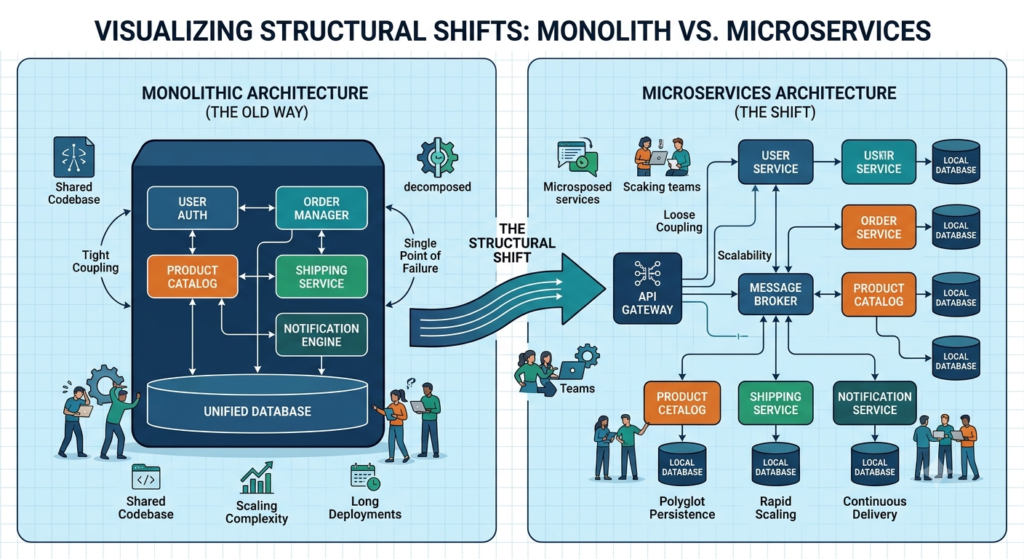
By understanding these fundamental evolutionary steps, trade-offs, and design patterns, you can confidently transition from writing isolated features to architecting globally scalable software systems.
Check this out to learn more about it – Software Architecture: Patterns, Trade-Offs, and Real-World Choices


I like how this post frames system design as solving business problems rather than just drawing architecture diagrams. One challenge teams often underestimate is balancing scalability with maintainability—designing for massive growth too early can add unnecessary complexity. It would be interesting to also explore how engineers decide when to evolve from a monolith to distributed services.