

 Ashish Sharma
Modern web applications serve millions of concurrent users, process petabytes of information, and demand round-the-clock availability. When an application outgrows its initial prototype, the database almost always becomes the primary bottleneck.
To overcome these performance walls, system architects rely on four foundational pillars:
- Strategic Scaling (Vertical vs. Horizontal)
- Data Replication (Leader-Follower and Read Replicas)
- Database Sharding (Range, Hash, Consistent Hashing, and Geo Partitioning)
- Polyglot Persistence (Matching storage engines to workload requirements)
This guide breaks down each strategy in clear, plain language, examines their real-world trade-offs, walks through production case studies from Netflix and Uber, and provides an end-to-end architectural blueprint.
Scaling Strategies: SQL (Vertical) vs. NoSQL (Horizontal)
When traffic surges, databases slow down. Software teams generally take one of two paths to address this bottleneck: scale up (vertical scaling) or scale out (horizontal scaling).
        Vertical Scaling (Scale-Up)            Horizontal Scaling (Scale-Out)
        ┌──────────────────────────┐            ┌───────┐ ┌───────┐ ┌───────┐
        │       Bigger Box         │            │Node 1 │ │Node 2 │ │Node 3 │
        │   (More CPU / RAM / NVMe)│            └───┬───┘ └───┬───┘ └───┬───┘
        └──────────────────────────┘                └─────────┼─────────┘
                                                       Distributed Network
Vertical Scaling (Scale-Up)
Vertical scaling increases the computational power of a single machine by adding more CPU cores, RAM, and faster NVMe storage.
- How it works: You migrate your database engine to a larger cloud instance or hardware rack without fundamentally changing application code.
- Why teams choose it: Traditional SQL relational databases (such as PostgreSQL, Oracle, and MySQL) thrive on vertical scaling. It preserves strict ACID guarantees (Atomicity, Consistency, Isolation, Durability) and eliminates the networking complexity of distributed systems.
- The limitation: Every single machine eventually hits a physical hardware limit. Furthermore, upgrading high-end hardware produces diminishing returns at exponential costs. Most critically, a single machine remains a single point of failure (SPOF).
Horizontal Scaling (Scale-Out)
Horizontal scaling distributes both data storage and incoming requests across a cluster of independent server nodes.
- How it works: Instead of buying a supercomputer, you pool together dozens or hundreds of commodity servers. When traffic increases, you provision additional nodes dynamically.
- Why teams choose it: NoSQL systems (such as Apache Cassandra, MongoDB, and Amazon DynamoDB) incorporate distributed horizontal scaling by design. This model allows internet-scale applications to expand storage capacity and request throughput incrementally.
- The trade-off: Distributing data introduces network partitions, distributed transactions, and replication delays. Consequently, many horizontally distributed databases relax immediate ACID guarantees, adopting eventual consistency to maintain ultra-high availability.
Decision Matrix: When to Use Which
| Requirement | Vertical Scaling (SQL) | Horizontal Scaling (NoSQL) |
|---|---|---|
| Primary Goal | Transactional integrity & simplicity | Global scale & fault tolerance |
| Data Structure | Structured relational tables with schema | Semi-structured, document, key-value |
| Write/Read Volume | Moderate to high (fits on one node) | Massive, global internet-scale traffic |
| Consistency Requirement | Immediate, strong consistency | Often eventual consistency |
| Operational Overhead | Low to moderate | High (requires distributed management) |
Database Replication: Resilience and Read Scalability
A single database server poses an unacceptable business risk. If that machine crashes, your entire service drops offline. Replication solves this problem by continuously copying the same dataset across multiple database instances.
                    ┌─────────────────────────┐
                    │      Client Writes      │
                    └────────────┬────────────┘
                                 │
                                 ▼
                     ┌───────────────────────┐
                     │   Leader (Primary)    │
                     │  Handles all writes   │
                     └───────────┬───────────┘
                                 │
                 ┌───────────────┴───────────────┐
                 │ Asynchronous Replication Log  │
                 ▼                               ▼
       ┌───────────────────┐           ┌───────────────────┐
       │ Follower Replica  │           │ Follower Replica  │
       │   Serves reads    │           │   Serves reads    │
       └─────────▲─────────┘           └─────────▲─────────┘
                 │                               │
                 └───────────────┬───────────────┘
                                 │
                    ┌────────────┴────────────┐
                    │      Client Reads       │
                    └─────────────────────────┘
Primary Benefits of Replication
- High Availability & Fault Tolerance: If a primary server fails, a replica quickly assumes the leader role (failover), minimizing application downtime.
- Geographic Proximity: Placing read replicas in data centers near your end users drastically cuts network latency.
- Read Throughput: In most web platforms—such as news sites, e-commerce stores, and social feeds—users read data thousands of times more often than they write data. Replicas absorb read traffic so the primary node stays fast and responsive.
Leader-Follower (Primary-Secondary) Architecture
In this standard architecture, the cluster assigns specialized roles to its nodes:
- The Leader (Primary): Accepts and commits every write operation (INSERT, UPDATE, DELETE). It writes changes to a local write-ahead log (WAL) and serves as the single source of truth.
- The Followers (Secondary / Read Replicas): Ingest and apply the leader’s change stream. Followers handle read-only queries from application servers.
The Asynchronous Replication Trade-Off
In high-throughput systems, leaders replicate changes asynchronously to maintain peak write speeds. As a result, a brief time window (often milliseconds) exists where followers lag behind the primary node.
- Use-Case Scenario (E-Commerce): A shopper browsing product catalogs reads from a nearby read replica. Seeing a product rating that is 500 milliseconds out of date does not hurt the customer experience.
- Use-Case Scenario (Banking): When a user transfers funds, viewing an outdated balance causes confusion and support tickets. Therefore, financial systems either force critical account reads directly through the leader node or use synchronous consensus protocols (such as Raft or Paxos) to guarantee immediate read-after-write consistency.
Database Sharding: Scaling Write Throughput and Storage Capacity
Replication successfully scales reads, but it cannot solve a write bottleneck. Because every replica must process every single write, your entire cluster remains limited by the processing capacity and disk space of a single machine.
When write volume and total storage outstrip single-node limits, architects turn to sharding.
Sharding breaks down a massive database into smaller, independent partitions called shards. Each individual shard operates on its own dedicated server and manages a unique slice of the total dataset.
                              Incoming Requests
                                      │
                                      ▼
                          ┌───────────────────────┐
                          │    Router / Gateway   │
                          │   (Evaluates Shard)   │
                          └───────────┬───────────┘
                                      │
         ┌────────────────────────────┼────────────────────────────┐
         ▼                            ▼                            ▼
┌─────────────────┐          ┌─────────────────┐          ┌─────────────────┐
│     Shard 1     │          │     Shard 2     │          │     Shard 3     │
│  User ID 1-100k │          │User ID 101k-200k│          │User ID 201k-300k│
└─────────────────┘          └─────────────────┘          └─────────────────┘
Horizontal vs. Vertical Sharding
- Horizontal Sharding (Row-Based Partitioning): Divides rows of the same table across different nodes using a designated shard key (e.g., distributing users across servers based on
user_id). - Vertical Sharding (Feature-Based Partitioning): Separates distinct tables and business domains into separate database instances (e.g., isolating User Profiles, Invoicing, and Product Inventory into distinct databases).
In-Depth Comparison of Sharding Strategies
Choosing the right partition scheme determines how evenly your system balances workload traffic.
       Range-Based                         Hash-Based                     Consistent Hashing Ring
  [0-100]    [101-200]             hash(key) % N -> Shard              Node A        Node B
  ┌─────┐     ┌─────┐                                                     \            /
  │  1  │     │  2  │              Even distribution, but                   \  Keys  /
  └─────┘     └─────┘              adding nodes requires                         O
Hotspots if data is sequential.    costly cluster-wide rebalancing.         /          \
                                                                          Node D        Node C
                                                                    Only K/N keys move on resize.
1. Range-Based Sharding
Range-based sharding groups data by contiguous value ranges of a selected attribute (for example, assigning IDs 1 to 10,000 to Shard 1 and 10,001 to 20,000 to Shard 2).
- Advantages: It executes range queries (such as retrieving orders placed within a date window) with exceptional efficiency because related records sit together on the same physical node.
- Disadvantages: It frequently triggers hotspots. For instance, if an application assigns auto-incrementing IDs or uses timestamps, all current writes bombard the newest shard while older shards sit idle.
2. Hash-Based Sharding
Hash-based sharding applies a cryptographic or mathematical hash function (e.g., hash(user_id) % total_shards) to map keys uniformly across available shards.
- Advantages: It distributes records evenly, preventing hot partitions and optimizing resource utilization across your hardware fleet.
- Disadvantages: It destroys data locality. Simple range queries now require scattering requests across every shard in the cluster and assembling the combined results (Scatter-Gather queries), which drives up query latency.
3. Consistent Hashing
Traditional modulo hashing breaks down whenever an operations team adds or removes a node because changing the divisor (N) forces almost all keys to remap to new nodes.
Consistent hashing solves this problem by imagining the hash space as a continuous, circular ring (0 to 232−1).
- How it works: Nodes and keys map to positions along this ring. A key belongs to the first node encountered moving clockwise.
- Why it matters: When engineers add or remove a node, the cluster only moves a fraction of the keys (K/N, where K is the number of keys and N is the number of nodes).
- Production adoption: Distributed engines like Apache Cassandra, Amazon DynamoDB, and Redis Cluster leverage consistent hashing with virtual nodes to achieve seamless, zero-downtime scaling.
4. Geo-Based Sharding
Geo-based sharding assigns records to physical data centers according to the user’s geographic location (e.g., EU users write to Frankfurt; US users write to Virginia).
- Advantages: It keeps data physically close to users, cutting network latency down to single-digit milliseconds. Simultaneously, it simplifies compliance with international data privacy laws (such as GDPR).
- Disadvantages: Traffic patterns skew heavily based on active timezones, leading to uneven global resource consumption throughout a 24-hour cycle.
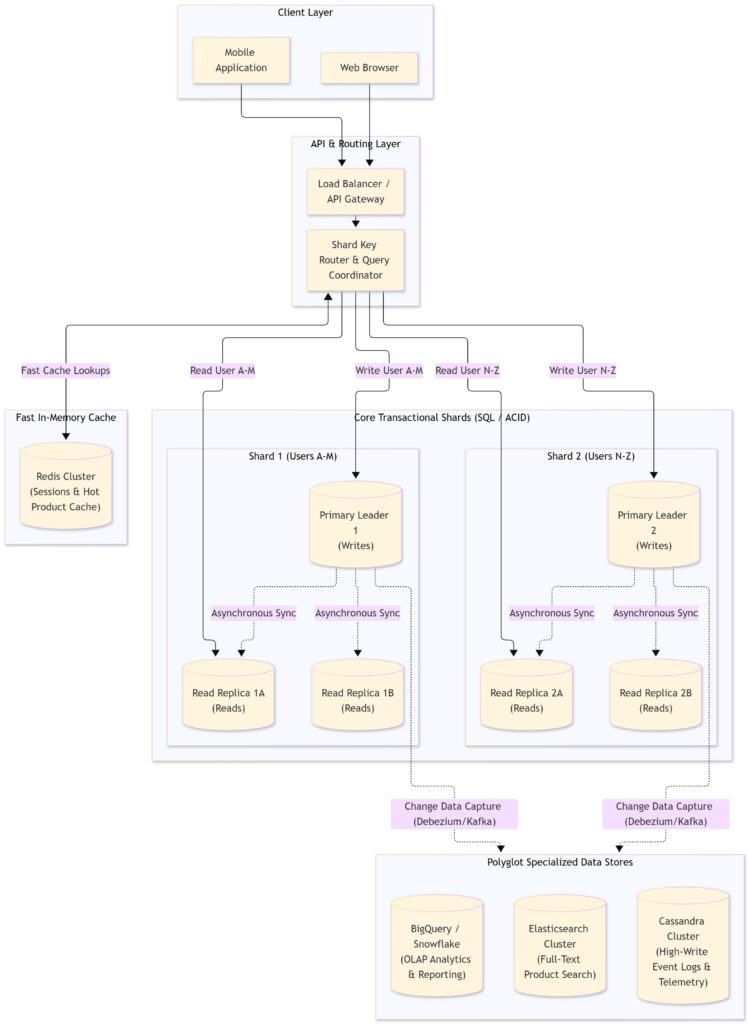
Architectural Blueprint: Modern Distributed Database Tier
The following diagram illustrates how modern architectures combine Caching, Leader-Follower Read Replicas, Sharding, and Polyglot Persistence into a single cohesive production engine:
Polyglot Persistence: Choosing the Right Engine for the Job
In the early days of web software, engineering teams routinely stored user sessions, catalog records, financial transactions, and log files inside a single relational database. However, modern workloads exhibit drastically different performance profiles:
- Transactions demand strict ACID isolation.
- Product catalogs require schema flexibility.
- Search features require inverted indexing.
- Analytics dashboards require aggregations across billions of rows.
Polyglot persistence recognizes that no single database engine handles every workload optimally. Instead, architects integrate specialized storage engines alongside their primary database.
                              Application Services
                                       │
        ┌──────────────┬───────────────┼───────────────┬──────────────┐
        │              │               │               │              │
        ▼              ▼               ▼               ▼              ▼
┌──────────────┐ ┌───────────┐ ┌───────────────┐ ┌───────────┐ ┌─────────────┐
│  Relational  │ │ Key-Value │ │ Document Store│ │Search Eng.│ │   Columnar  │
│ (PostgreSQL) │ │  (Redis)  │ │   (MongoDB)   │ │  (Elastic)│ │ (Snowflake) │
├──────────────┤ ├───────────┤ ├───────────────┤ ├───────────┤ ├─────────────┤
│ Core Billing │ │ Sessions  │ │ Product Specs │ │ Full-Text │ │ BI Reports  │
│ & Orders     │ │ & Caching │ │ & Catalogs    │ │ & Autocmpl│ │ & Analytics │
└──────────────┘ └───────────┘ └───────────────┘ └───────────┘ └─────────────┘
Workload-to-Engine Mapping
| Engine Type | Representative Technologies | Best Workload Fit | When to Avoid |
|---|---|---|---|
| Relational (RDBMS) | PostgreSQL, MySQL, CockroachDB | Financial ledgers, user accounts, order checkouts | High-frequency telemetry streams, unstructured data |
| Key-Value | Redis, AWS DynamoDB, Memcached | Session state, rate limiters, transient caching | Complex analytical queries, multi-table joins |
| Document Store | MongoDB, Couchbase | Product catalogs with varying attributes, user profiles | Strict schema enforcement, complex cross-collection joins |
| Search Engine | Elasticsearch, OpenSearch, Meilisearch | Full-text search, fuzzy matching, faceted filtering | Primary source of truth for transactional records |
| Wide-Column | Apache Cassandra, ScyllaDB | IoT time-series logs, message history, tracking data | Low-latency ad-hoc joins and aggregations |
| Columnar (OLAP) | BigQuery, Snowflake, ClickHouse | Business intelligence, historical analysis, ETL | Real-time row-by-row lookups and OLTP writes |
Real-World Case Studies
1. How Netflix Uses Polyglot Persistence
- Apache Cassandra: Absorbs massive write volumes from streaming telemetry, bookmarks, and viewing history across globally distributed clusters.
- Amazon DynamoDB: Stores user accounts, subscription state, and critical application metadata with low latency and high availability.
- Elasticsearch: Powers real-time search, auto-completion, and title suggestions in the user interface.
- Relational Databases (MySQL/Aurora): Manages internal billing records, accounting transactions, and partner revenue sharing where absolute financial consistency is required.
2. How Uber Powers Real-Time Rides
- Redis: Caches real-time driver locations, dynamic surge pricing calculations, and active session tokens for immediate retrieval.
- PostgreSQL / MySQL (Docstore Layer): Manages core user trip records, payment workflows, and business contracts under robust relational schemas.
- Apache Hadoop & Google BigQuery: Processes billions of daily trip trajectories and geospatial records to power fraud detection and dispatch algorithm optimization.
System Design Interview Cheat Sheet: Essential Q&A
Distributed database concepts appear constantly in technical system design interviews. Review these concise answers to tackle common architecture challenges:
Q1: What is the core difference between horizontal and vertical scaling, and when should you choose each?
- Vertical Scaling: Increases the CPU, RAM, and SSD storage of a single host. Choose vertical scaling when simplicity and immediate consistency are paramount and your data fits on a single machine.
- Horizontal Scaling: Adds more independent machines to a distributed cluster. Choose horizontal scaling when internet-scale traffic, continuous storage growth, or strict fault-tolerance requirements exceed single-machine limits.
Q2: How does asynchronous leader-follower replication impact the CAP theorem?
Leader-follower setups prioritize Availability (A) and Partition Tolerance (P) over immediate Consistency (C). Because the leader commits changes locally before replicas receive them, followers temporarily return stale data during replication lag. If a network partition isolates the leader, systems choose between rejecting writes to preserve consistency (CP) or accepting writes on alternate nodes risking split-brain anomalies (AP).
Q3: What are the main benefits and drawbacks of read replicas?
- Pros: Multiplies read query throughput, prevents read queries from locking the primary write node, and offers regional read caching.
- Cons: Introduces replication lag (eventual consistency), requires application-side query routing logic, and offers zero write-scaling capacity.
Q4: Compare range-based and hash-based sharding. What are their fundamental trade-offs?
- Range-Based Sharding: Groups data by sequential key values. It accelerates range queries but routinely creates write hotspots on the newest ranges.
- Hash-Based Sharding: Distributes rows evenly using a mathematical hash function. It prevents hotspots and spreads hardware load evenly, but it renders cross-shard range queries slow and expensive.
Q5: Why is consistent hashing crucial for distributed databases like Cassandra and DynamoDB?
Standard modular hashing (key % N) invalidates almost all key-to-node assignments when the cluster adds or removes a node. Consistent hashing arranges nodes on a logical ring so that cluster resizing only moves keys assigned to neighboring nodes (K/N). This design guarantees dynamic elasticity with minimal data reshuffling.
Summary and Key Takeaways
Scaling a production database is never a binary choice between SQL and NoSQL. Mature systems deliberately combine multiple architectural strategies as they expand:
- Start with Simplicity: Begin with a robust relational database (like PostgreSQL) and leverage vertical scaling until performance constraints emerge.
- Scale Reads First: Deploy asynchronous read replicas to offload read-heavy traffic without altering your underlying schema.
- Shard to Scale Writes and Storage: Implement sharding with consistent hashing when write volume and data storage exceed the limits of your largest single node.
- Embrace Polyglot Persistence with Caution: Introduce specialized storage engines (such as Redis for caching or Elasticsearch for search) only when distinct workload demands justify the additional operational maintenance.
Understanding these trade-offs empowers you to design robust, cost-effective distributed systems that scale gracefully from thousands to hundreds of millions of users.