

 Ashish Sharma
Introduction: Why Storage Dictates System Scalability
Every scalable digital product revolves around one critical asset: data. Users generate information, microservices process it, and businesses depend on retaining it accurately over time. Whenever data must survive beyond a single HTTP request or an abrupt server reboot, storage stops being an afterthought and becomes the core pillar of your system architecture.
Storage choices determine your application’s response latency, operational overhead, fault tolerance, and cost efficiency. For example, pairing a blazing-fast application server with an unoptimized disk subsystem creates severe bottlenecks. Similarly, utilizing an unreliable storage tier can turn a minor network hiccup into catastrophic data loss.
Every core feature—such as user profiles, shopping carts, product catalogs, recommendation feeds, and audit trails—relies on persistent storage. Consequently, system architects must look beyond simple capacity. You must design resilient architectures that store ballooning datasets efficiently, retrieve records rapidly, and stay online when hardware fails.
Classifying Data: Structured vs. Unstructured
Before selecting storage engines, you must analyze your data’s shape, access patterns, and schema guarantees. Workloads generally fall into two primary classifications:
                          ┌───────────────────────────┐
                          │   System Data Ingestion   │
                          └─────────────┬─────────────┘
                                        │
                 ┌──────────────────────┴──────────────────────┐
                 ▼                                             ▼
     ┌─────────────────────────┐                     ┌───────────────────────┐
     │    Structured Data      │                     │   Unstructured Data   │
     ├─────────────────────────┤                     ├───────────────────────┤
     │ • Strict tabular schema │                     │ • Schema-less blobs   │
     │ • Predictable rows      │                     │ • Binary objects      │
     │ • Relational queries    │                     │ • Metadata indexing   │
     │ • E.g., Users, Orders   │                     │ • E.g., Media, Logs   │
     └─────────────────────────┘                     └───────────────────────┘
Structured Data
Structured data adheres to a rigid, predefined schema organized into rows and columns.
- Key Characteristics: Predictable data types, strict integrity constraints, and relational schemas.
- Common Examples: User profiles, payment transactions, order records, and inventory ledgers.
- Storage Solution: Relational Database Management Systems (RDBMS) such as PostgreSQL, MySQL, and Oracle.
- Why It Matters: The strict uniformity of structured data allows the database engine to execute high-speed indexes, join operations, and ACID transactions with mathematical precision.
Unstructured Data
Unstructured data lacks a tabular structure and does not fit neatly into relational tables.
- Key Characteristics: Variable sizes, polymorphic formats, binary payloads, and metadata-driven access.
- Common Examples: High-resolution images, streaming videos, PDF invoices, application log archives, and audio recordings.
- Storage Solution: Distributed Object Stores (e.g., Amazon S3, Google Cloud Storage) and distributed file systems.
- Why It Matters: Querying binary streams with standard SQL queries is both inefficient and cost-prohibitive. Therefore, modern systems decouple raw content into scalable blob storage while maintaining lightweight reference pointers in a relational database.
The Four Pillars of Storage Architecture
Modern architectures avoid “one-size-fits-all” approaches. Instead, engineers assemble applications using four distinct storage models:
| Storage Type | Primary Access Interface | Latency Profile | Best Used For | Industry Examples |
|---|---|---|---|---|
| Databases | SQL / Query APIs / Key-Value | Low to Moderate (1ms – 50ms) | Transactional data, relational queries, entity graphs | PostgreSQL, MySQL, DynamoDB, MongoDB |
| Object Storage | RESTful HTTP APIs (GET/PUT) | Moderate (50ms – 200ms) | Static media, cold backups, log archives, big data dumps | Amazon S3, Cloudflare R2, MinIO |
| File Storage | Hierarchical POSIX (/dir/file) | Low to Moderate (5ms – 20ms) | Shared directories across multiple web instances, CMS assets | AWS EFS, NFS, SMB/CIFS |
| Block Storage | Raw Volumes (Fixed blocks) | Ultra-Low (<1ms – 5ms) | Database storage engines, VM boot volumes, high-IOPS applications | AWS EBS, SAN arrays, NVMe SSDs |
A. Database Storage
Databases manage structured and semi-structured application records that need continuous updates and complex filtering. While relational databases enforce ACID properties for transactions, NoSQL databases scale horizontally by relaxing constraints to handle massive read/write volumes.
B. Object Storage
Object storage manages discrete packages of data (objects) containing the payload, an expandable set of metadata tags, and a unique 128-bit or string identifier. Because it maintains a flat namespace instead of a nested folder tree, object storage scales effortlessly to petabytes of images, documents, and backups.
C. File Storage
File storage organizes files within a traditional directory hierarchy with folders, subfolders, and ownership permissions. It enables multiple operating systems and compute nodes to mount the exact same file tree concurrently.
D. Block Storage
Block storage splits raw storage capacity into evenly sized chunks called blocks. Each block operates as an independent disk sector without operating system file structure overhead. Consequently, block storage provides the ultra-fast I/O operations per second (IOPS) necessary to host database engines and container filesystems.
Critical Storage Guarantees: The Core Properties
When evaluating storage solutions, architects evaluate the behavioral guarantees a system provides under normal operation and catastrophic failures:
- Durability: The assurance that the storage engine preserves committed data against physical hardware failure, power loss, and disk decay. Distributed systems typically achieve durability through multi-zone replication, RAID arrays, and write-ahead transaction logs (WAL).
- Availability: The percentage of time that a storage cluster successfully receives requests and returns operational responses. High-availability clusters deploy health checks and automated failover nodes to eliminate single points of failure.
- Consistency: The guarantee that any read request immediately returns the most recent write. If node A accepts an account update, node B must display that exact state immediately to subsequent queries.
- Atomicity: The all-or-nothing principle for state modifications. If a multi-step operation (such as debiting checking account A and crediting savings account B) encounters an unexpected crash midway through, the engine rolls back all partial writes to maintain a valid state.
Architectural Trade-offs: The Iron Triangle of Storage
Storage design is not an exercise in perfection; it is an exercise in compromise. Every architectural adjustment shifts the balance between three opposing forces:
                          Scalability
                             ▲
                            / \
                           /   \
                          /     \
                         /       \
                        /  TRADE- \
                       /    OFFS   \
                      /             \
        Reliability  ◄───────────────►  Performance
- Scalability: The ability to ingest increasing read/write throughput and growing datasets by adding nodes (horizontal scaling) or compute power (vertical scaling).
- Reliability: The ability to safeguard data integrity and preserve cluster operations despite server crashes and severed fiber cables.
- Performance: The speed at which the system ingests writes and responds to reads with minimal latency.
These goals naturally oppose one another. For instance, replicating writes synchronously across five data centers increases reliability, but network transport delays immediately hurt write performance. Conversely, caching data in local RAM maximizes performance, yet risks losing uncommitted updates during power crashes, thus compromising reliability.
CAP Theorem
Formulated by computer scientist Eric Brewer, the CAP Theorem establishes that a distributed data store can simultaneously provide at most two of the following three guarantees:
                            Consistency (C)
                                  ▲
                                 / \
                                /   \
                               /     \
                              /   *   \  <-- Inevitable Network Partitions
                             /         \
                            /           \
              Availability ◄─────────────► Partition Tolerance (P)
                  (A)
- Consistency (C): Every read receives the latest write or returns an explicit error. All nodes reflect identical states simultaneously.
- Availability (A): Every non-failing node returns a non-error response for every received request, without guaranteeing that it contains the absolute latest write.
- Partition Tolerance (P): The cluster continues to operate even when network hardware drops, delays, or segments communication between physical servers.
The Real-World Reality: P is Non-Negotiable
In distributed environments, network connections inevitably encounter dropped packets, disconnected routers, and severed physical links. Because network partitions (P) are unavoidable physical realities, distributed systems must pick between Consistency (C) and Availability (A) during a partition event:
Distributed Storage Choice: P + (C ∨ A)
Important Distinction: CAP does not force a permanent binary choice during everyday operations. When the network functions normally, well-designed architectures deliver both consistency and availability. The CAP dilemma triggers strictly when a network partition divides the cluster.
Categorizing Systems by CAP Trade-Offs
Distributed databases classify themselves based on how they behave when network communication breaks:
CP Systems (Consistency + Partition Tolerance)
CP systems preserve data correctness above everything else. If an isolated replica cannot communicate with the primary cluster to verify state, it intentionally refuses incoming requests.
- Behavior Under Partition: The system drops incoming reads or writes, returning error codes rather than exposing stale or conflicting data.
- Ideal Workloads: Core banking, wire transfers, stock trading platforms, ticket seat reservations, and inventory checkouts.
- Representative Technologies: Apache HBase, Google Cloud Spanner, CockroachDB, and etcd.
AP Systems (Availability + Partition Tolerance)
AP systems prioritize continuous uptime and responsive user interfaces over immediate correctness.
- Behavior Under Partition: Every reachable node continues serving reads and accepting writes. Although users receive instantaneous responses, distinct nodes temporarily serve differing versions of data until the partition resolves and nodes synchronize (eventual consistency).
- Ideal Workloads: Social media feeds, product comment sections, streaming recommendations, and shopping carts.
- Representative Technologies: Apache Cassandra, Amazon DynamoDB, Couchbase, and Riak.
What About “CA” Systems?
A CA system promises both absolute consistency and uninterrupted availability. However, it can only fulfill this promise if network partitions never occur. Because physical network hardware will eventually drop packets, true CA systems exist strictly on single-node instances (such as a standalone PostgreSQL or SQLite database) running on a single physical machine. Once you distribute data across a network, CA becomes impossible.
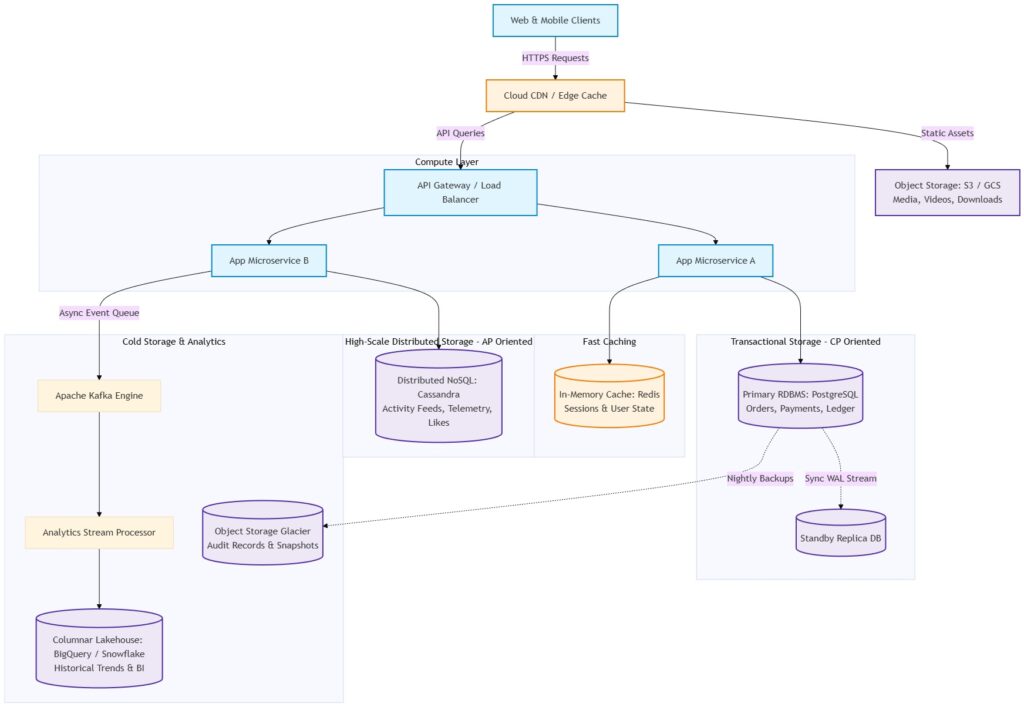
Architectural Diagram: Modern Polyglot Storage in Action
Enterprise systems rarely rely on a single storage technology. Instead, production architectures leverage polyglot persistence —routing distinct data types to purpose-built storage engines:
Real-World Use Cases & Storage Selection
Let us examine how industry platforms balance these patterns across practical production deployments:
Case 1: The Modern E-Commerce Platform
- The Challenge: The business must manage inventory, process customer payments, present high-resolution product photography, and track shopping sessions across millions of simultaneous shoppers.
- Storage Allocation:
- Relational Database (CP – PostgreSQL): Manages user balances, discount codes, inventory totals, and payments via ACID transactions.
- In-Memory Store (Redis): Caches user shopping carts and active login sessions for sub-millisecond retrieval.
- Object Store (Amazon S3): Stores millions of raw and web-optimized product images, videos, and generated PDF VAT receipts.
Case 2: Global Video Streaming Service (e.g., Netflix)
- The Challenge: The platform streams gigabytes of media payload to a worldwide audience while generating personalized recommendations and logging watch progression.
- Storage Allocation:
- Distributed Object Store (S3 / CDN Edges): Delivers encrypted 4K video segments and media thumbnails distributed globally close to the consumer.
- Distributed NoSQL Store (AP – Apache Cassandra): Captures high-frequency viewer interactions, bookmark positions (e.g., resuming at minute 42:10), and viewing history without lagging.
Case 3: Observability & Log Analytics Pipeline
- The Challenge: Microservices produce millions of log lines per second. Engineers require instantaneous search access over recent anomalies, while compliance teams mandate retaining five years of historical audit records.
- Storage Allocation:
- Columnar / Time-Series Database (ClickHouse / Elasticsearch): Indexes the last 14 days of logs to facilitate lightning-fast operational searches, metrics aggregation, and incident dashboards.
- Object Storage Lifecycle Rules (S3 Glacier): Automatically compresses and moves telemetry logs older than 30 days into cold archive buckets, lowering infrastructure expenditures by over 80%.
Summary and Key Takeaways
- Storage Drives System Architecture: Storage solutions govern system response latency, cost profiles, and scalability ceilings.
- Classify Data Early: Differentiate structured transactional data from unstructured binary assets before selecting infrastructure components.
- Combine Storage Types: Enterprise architectures thrive on polyglot persistence, pairing block storage, relational databases, distributed NoSQL, and object stores.
- Respect CAP Constraints: Distributed networks will inevitably partition. Select CP when data correctness is critical, and choose AP when system uptime takes priority.
- Optimize for the Workload: Never ask what database is “best.” Analyze your query access patterns, throughput requirements, and business goals to select the right engine for the job.