 Ashish Sharma
Introduction: Why Database Selection Dictates System Success
Every meaningful software application requires data to survive beyond a single server restart or HTTP request. A database serves as the foundation of your system, providing persistent storage while allowing applications to query, filter, update, and manage state efficiently.
Modern systems treat the database as their ultimate source of truth. However, scaling an application from a simple prototype to an enterprise platform serving millions of concurrent users introduces complex trade-offs.
Engineers face a fundamental architectural choice: SQL (Relational) or NoSQL (Non-Relational). Rather than asking which database is universally superior, architects evaluate how well a database model aligns with their specific data structure, access patterns, scalability targets, and consistency requirements.
Relational Databases (SQL): Structure, Relationships, and ACID Guarantees
Relational databases have served as the backbone of enterprise software for decades. They organize data into structured tables consisting of rows and columns, making connections between entities explicit and manageable.
+-------------------------------------------------------------+
|                      SQL Table: Users                       |
+----+-------------+-------------------------+----------------+
| id | name        | email                   | created_at     |
+----+-------------+-------------------------+----------------+
| 1  | Alex Morgan | alex.morgan@example.com | 2026-01-10     |
| 2  | Jamie Chen  | jamie.chen@example.com  | 2026-02-14     |
+----+-------------+-------------------------+----------------+
The Three Pillars of SQL
- Schema-First Discipline: Engineers must define tables, columns, data types, and integrity constraints before writing data. Consequently, this strict schema acts as a contract, preventing data corruption and enforcing data hygiene across large engineering teams.
- Relational Joins: Real-world applications separate data into normalized tables—such as customers, orders, payments, and shipments. Relational engines execute complex
JOINqueries to aggregate and filter across these relationships without duplicating data. - ACID Transactions: Relational databases provide four non-negotiable guarantees to protect data integrity:
- Atomicity: All operations within a transaction succeed completely, or the database rolls back every change.
- Consistency: Every transaction moves the database from one valid state to another, strictly adhering to all constraints.
- Isolation: Concurrent transactions execute independently without interfering with one another.
- Durability: Once a transaction commits, its changes survive system crashes and hardware power failures.
Real-World SQL Examples and Ideal Scenarios
- Top Technologies: PostgreSQL, MySQL, Oracle Database, Microsoft SQL Server.
- Best Use Cases: Core banking engines, payment processing pipelines, ERP systems, healthcare records, and inventory management—anywhere transactional precision and zero data loss are mission-critical.
Limitations of Relational Databases
While SQL systems excel at transactional consistency, they introduce clear trade-offs:
- Difficult Horizontal Scalability: SQL engines scale effortlessly vertically (by adding CPU, RAM, and faster NVMe drives). However, scaling horizontally across dozens of machines requires complex database sharding and distributed locks that add high operational overhead.
- Schema Rigidity: Modifying schema structures on multi-terabyte tables can lock rows and complicate continuous deployment pipelines.
- Object-Relational Impedance Mismatch: Applications frequently exchange nested JSON payloads and dynamic documents that do not map naturally to flat rows and columns.
Non-Relational Databases (NoSQL): Flexibility, Throughput, and Distributed Scale
As web traffic surged and global platforms began processing petabytes of user-generated events, traditional relational databases struggled to deliver sub-millisecond response times at scale. Engineers built NoSQL systems to prioritize flexible schemas, horizontal partition tolerance, and high write throughput.
Importantly, NoSQL does not represent a single database engine. Instead, it describes a family of distinct data storage models, each optimized for a specific data access pattern.
+-------------------------------------------------------------------------+
|                         The 4 NoSQL Paradigms                           |
+-------------------+-------------------+-------------------+-------------+
|   Document DB     |  Key-Value Store  | Wide-Column Store |  Graph DB   |
| (JSON Documents)  | (Fast Hash-Table) | (Column Families) | (Nodes &    |
|                   |                   |                   |  Edges)     |
|  e.g., MongoDB    |   e.g., Redis     |  e.g., Cassandra  | e.g., Neo4j |
+-------------------+-------------------+-------------------+-------------+
The Four Major NoSQL Categories
A. Document Databases
Document stores persist records as structured, hierarchical documents (typically JSON or BSON). They eliminate the need for cross-table joins by embedding related arrays and sub-objects directly within the parent document.
- Leading Engines: MongoDB, Couchbase, Amazon DocumentDB.
- Ideal Use Cases: Content management platforms, user profiles, product catalogs with varying attributes, and blogging platforms.
B. Key-Value Stores
Key-value stores operate like distributed hash tables. Given an exact key, the engine retrieves or writes the associated value with sub-millisecond latency.
- Leading Engines: Redis, AWS DynamoDB, Memcached.
- Ideal Use Cases: User authentication session storage, real-time leaderboards, API response caching, and temporary shopping carts.
C. Wide-Column (Columnar) Stores
Unlike traditional row-oriented databases, columnar engines store and organize data by columns rather than rows. Consequently, they ingest massive write volumes across distributed clusters and execute high-speed aggregation queries over vast datasets.
- Leading Engines: Apache Cassandra, Apache HBase, ScyllaDB.
- Ideal Use Cases: Time-series telemetry, Internet of Things (IoT) sensor streams, financial market ticks, and distributed application logging.
D. Graph Databases
Graph databases place relationships on equal footing with data entities. They model data as nodes (entities), edges (relationships), and properties, allowing engines to traverse multi-hop connections in constant time without costly relational joins.
- Leading Engines: Neo4j, Amazon Neptune, ArangoDB.
- Ideal Use Cases: Social network friend graphs, real-time fraud detection rings, recommendation engines, and identity access control graphs.
Theoretical Foundations: ACID vs. BASE and the CAP Theorem
Distributed database architecture relies on two foundational theoretical models: the contrast between ACID and BASE, and the constraints of the CAP theorem.
ACID vs. BASE
While relational databases rely on strict ACID guarantees, many distributed NoSQL systems embrace the BASE philosophy to maximize performance:
| Property | ACID (Relational / SQL) | BASE (Distributed / NoSQL) |
|---|---|---|
| Availability | Prioritizes immediate consistency; may reject writes during conflicts. | Basically Available: Guarantees cluster availability even during node failures. |
| State Consistency | Deterministic; every replica maintains identical state instantly. | Soft State: Replicas may temporarily hold divergent values during sync routines. |
| Convergence | Immediate consistency across all readers. | Eventual Consistency: Replicas synchronize across the network over time. |
For instance, when a user posts a photo on social media, their followers do not need to see the update within the exact same millisecond. Therefore, social platforms leverage eventual consistency to preserve high availability.
The CAP Theorem
Eric Brewer’s CAP Theorem demonstrates that any distributed data store can guarantee at most two out of three properties during system operation:
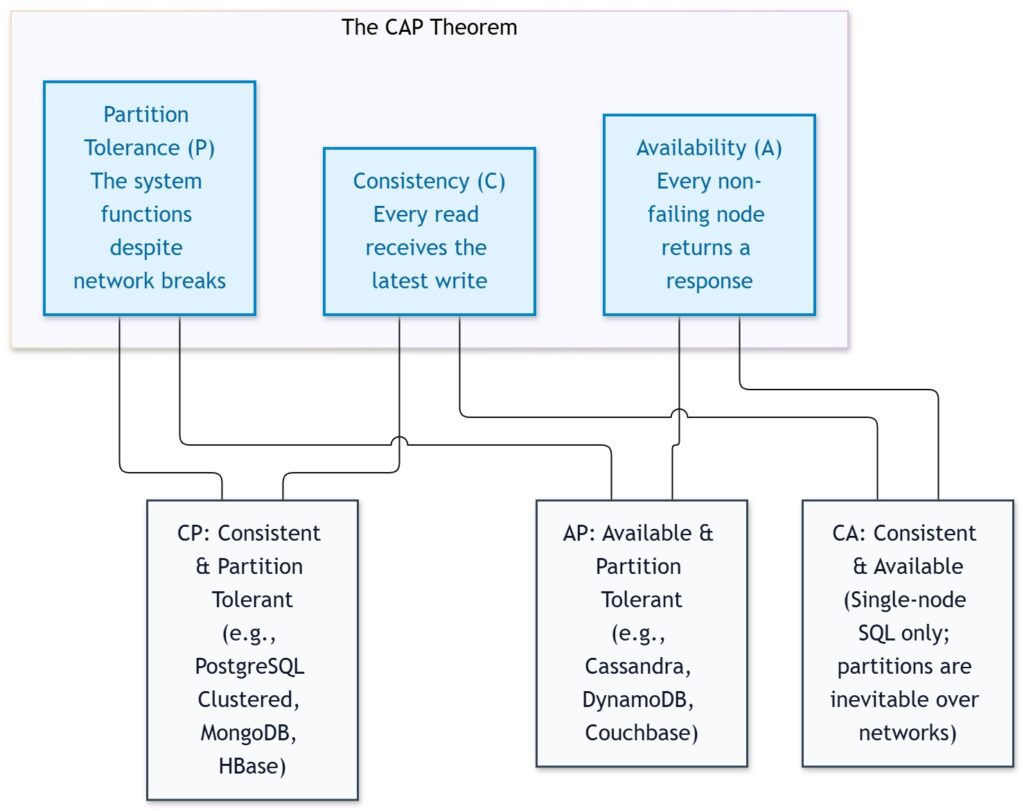
Because network partitions (dropped packets, latency spikes, severed connections) are inevitable in distributed systems, architects cannot choose CA for distributed clusters. Consequently, systems must balance between two choices during a partition:
- CP Systems (Consistency + Partition Tolerance): The system declines or pauses requests to prevent serving stale or conflicting data. Clustered SQL systems, HBase, and default MongoDB configurations prioritize this model.
- AP Systems (Availability + Partition Tolerance): Nodes accept reads and writes immediately, returning existing local data even if some nodes have not synchronized. Systems like Cassandra and DynamoDB use this model to guarantee uptime.
Direct Comparison: SQL vs. NoSQL
The following table summarizes the core trade-offs between both database paradigms:
| Feature | SQL (Relational Databases) | NoSQL (Non-Relational Databases) |
|---|---|---|
| Data Schema | Rigid, predefined, strongly typed. | Dynamic, flexible, schema-on-read. |
| Data Organization | Normalized tables with rows and columns. | Key-value pairs, JSON documents, column families, graphs. |
| Query Mechanism | Structured Query Language (SQL). | Specialized APIs, JSON query objects, graph languages (e.g., Cypher). |
| Relationship Model | Enforced via Foreign Keys and multi-table JOIN operations. | Denormalized records, embedded objects, or graph traversals. |
| Scaling Strategy | Predominantly Vertical (Scale-Up); complex to shard. | Native Horizontal (Scale-Out across commodity nodes). |
| Transaction Model | Strict ACID compliance. | BASE model, tunable consistency, eventual consistency. |
| Best Suited For | Financial ledgers, ERP, e-commerce checkouts. | High-volume IoT telemetry, real-time analytics, mobile backends. |
Real-World Architecture: The Power of Polyglot Persistence
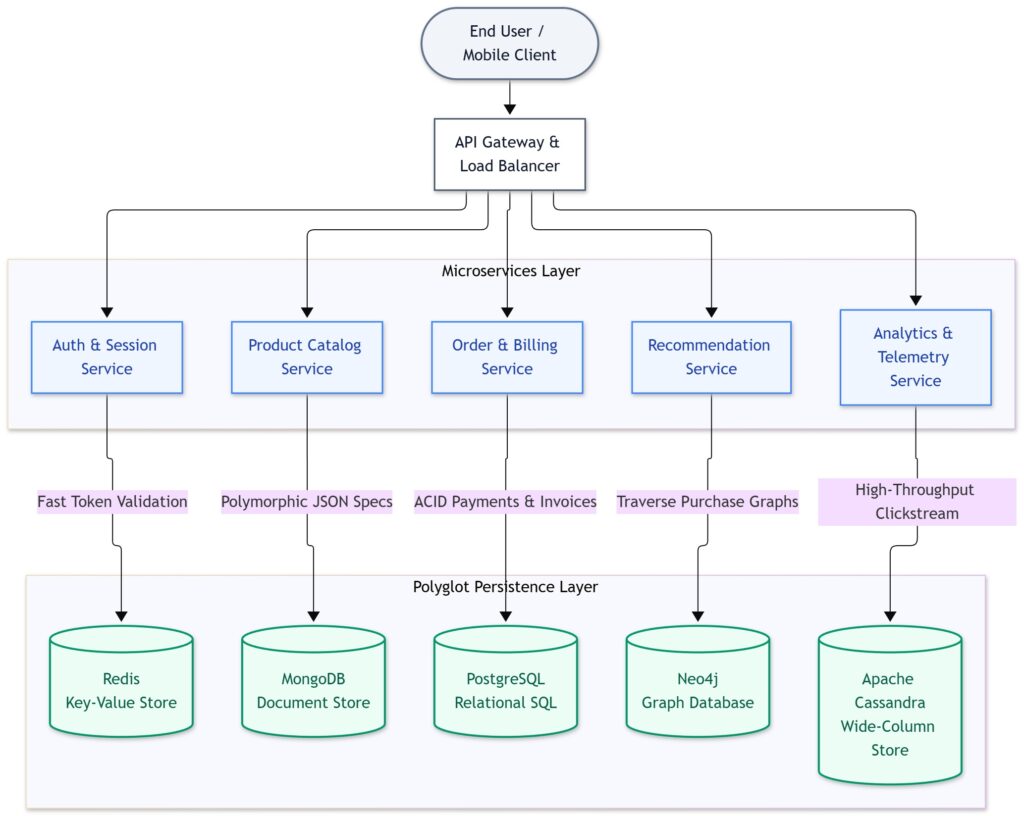
Modern engineering teams rarely force an entire enterprise application into a single database engine. Instead, they apply Polyglot Persistence—an architectural pattern where teams deploy multiple specialized database engines to support different bounded contexts across microservices.
The following architectural diagram illustrates how an enterprise e-commerce system assigns each database technology to its ideal operational workload:
Why This Architecture Works:
- Fast Session Lookups: Redis processes session tokens with sub-millisecond in-memory lookups.
- Dynamic Catalog Attributes: MongoDB stores nested product details (e.g., clothing sizes, laptop hardware specifications) without requiring schema migrations.
- Accurate Financial Records: PostgreSQL manages inventory counts, credit card transactions, and customer invoices under strict ACID rules.
- Personalized Recommendations: Neo4j evaluates deep connection paths (e.g., “Users who bought item X and follow author Y also purchased Z”).
- Massive Ingestion: Cassandra captures millions of telemetry click events without saturating primary application databases.
Decision Framework: When to Choose What?
To determine the right database for your system, evaluate your application against these practical criteria:
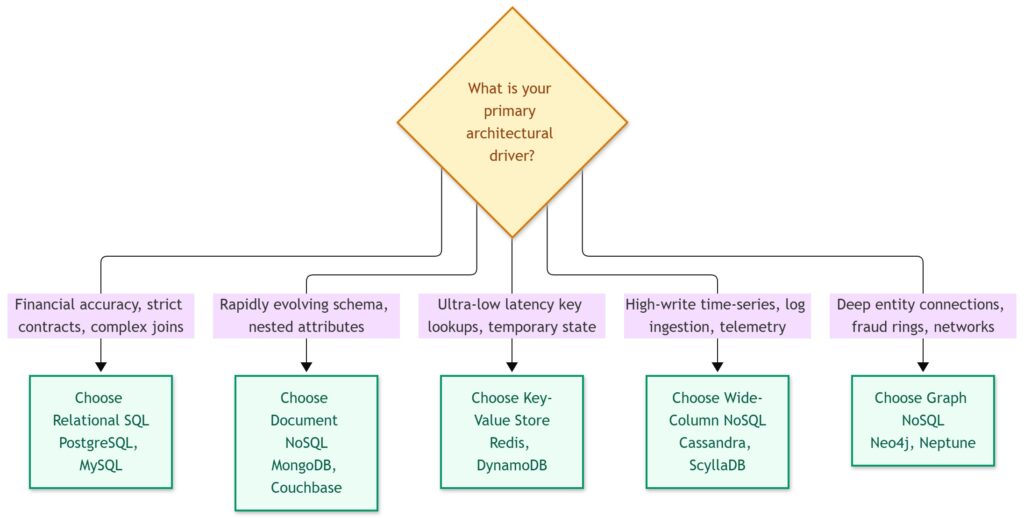
Scenario Breakdown
- Financial Ledger & Billing System:
- Recommendation: SQL (e.g., PostgreSQL).
- Rationale: Double-entry bookkeeping requires strict ACID compliance. The system must prevent debiting one account without crediting another, making immediate consistency essential.
- Global Product Catalog:
- Recommendation: NoSQL Document Store (e.g., MongoDB).
- Rationale: Products feature diverse, rapidly changing attributes (e.g., shoes have shoe sizes; laptops have RAM and processor speeds). Document stores persist these heterogeneous attributes effortlessly.
- High-Throughput Chat Messaging Application:
- Recommendation: NoSQL Key-Value / Wide-Column Store (e.g., DynamoDB or Cassandra paired with Redis).
- Rationale: Chat apps generate massive write volumes, require low latency, and tolerate eventual consistency across distributed conversation windows.
- Fraud Detection & Social Graphs:
- Recommendation: Graph Database (e.g., Neo4j).
- Rationale: Detecting coordinated credit card fraud requires analyzing multi-hop relationships across accounts, shared IP addresses, and phone numbers in real time.
Summary & Key Takeaways
Database selection is not a contest between old and new technologies. Experienced software architects evaluate system requirements and match each storage engine to the application’s unique access patterns:
- Choose SQL when data consistency, relational modeling, and transactional correctness are critical.
- Choose NoSQL when horizontal scale, schema adaptability, high write velocity, or specialized relationship traversals take priority.
- Embrace Polyglot Persistence in large systems to deploy the best database for each specific microservice rather than forcing every workload into a single database.