 Ashish Sharma
Modern web applications depend heavily on transport layer protocols to move data across unpredictable networks. Network traffic faces delays, packet loss, and out-of-order delivery. Therefore, software architects must choose between Transmission Control Protocol (TCP) and User Datagram Protocol (UDP) based on trade-offs between absolute reliability and low latency.
This guide explores how TCP and UDP operate, their key differences, real-world use cases, and how to select the right protocol for your system design.
Transmission Control Protocol (TCP)
TCP prioritizes correctness and data integrity over raw speed. It creates a reliable communication channel over unstable networks by adding tracking, acknowledgments, and ordering mechanisms.
Key Mechanisms
- Three-Way Handshake: TCP establishes a formal session before transmitting data. The client and server exchange
SYN,SYN-ACK, andACKsegments to synchronize sequence numbers. - Ordered Delivery: Every segment receives a sequence number. If packets travel across different routes and arrive out of order, TCP reassembles them sequentially before passing them to the application.
- Retransmission & ACKs: The receiver sends back acknowledgment (
ACK) packets. If the sender does not receive anACKwithin a set timeout, it automatically retransmits the missing data. - Congestion Control & Flow Control: TCP dynamically throttles data transfer rates based on network capacity and receiver memory limits.
TCP Three-Way Handshake:
Client                   Server
  |    SYN (Seq=X)         |
  |----------------------->|
  |    SYN-ACK (Ack=X+1)   |
  |<-----------------------|
  |    ACK (Ack=Y+1)       |
  |----------------------->|
  |    Data Flow Begins    |
Trade-off: Connection setup, error checking, and retransmission introduce latency and CPU overhead. However, TCP guarantees that what you send is exactly what arrives.
User Datagram Protocol (UDP)
UDP prioritizes speed, minimal protocol overhead, and low latency. It provides connectionless, best-effort delivery without verifying whether packets reach their destination.
Key Mechanisms
- Connectionless Setup: UDP sends packets (datagrams) immediately without performing a preliminary handshake.
- No Acknowledgments or Retransmission: The protocol drops missing or corrupted packets without attempting recovery.
- Lightweight Header: UDP uses an 8-byte header, compared to TCP’s 20-byte header, reducing network bandwidth overhead.
- No State Tracking: The server does not maintain session state or sequence numbers, allowing it to handle massive volumes of incoming datagrams efficiently.
Trade-off: UDP provides no guarantees regarding packet loss, duplication, or arrival order. If reliability is needed, the application layer must implement its own recovery logic.
Protocol Comparison & Architectural Trade-offs
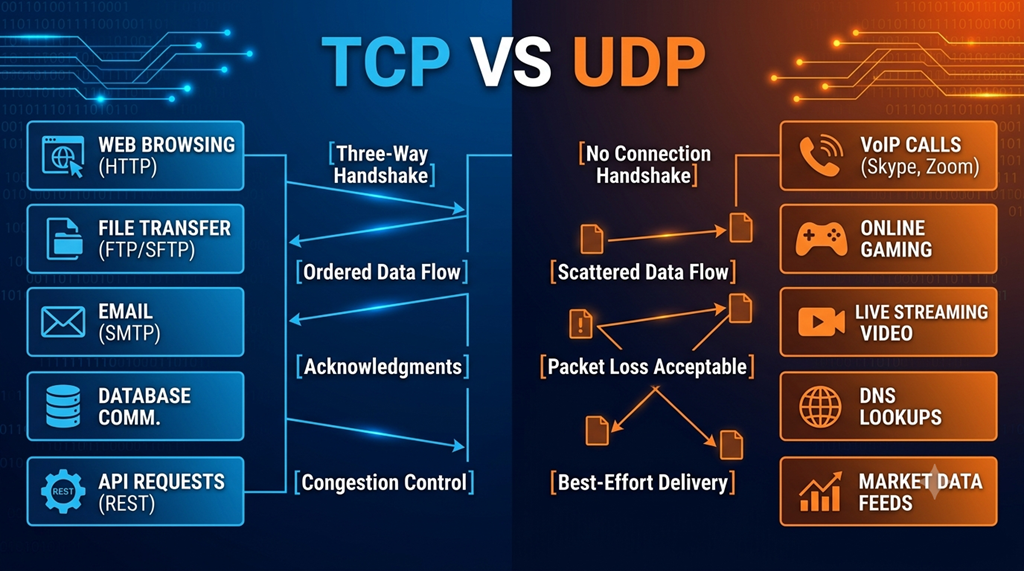
| Feature | TCP (Transmission Control Protocol) | UDP (User Datagram Protocol) |
| Connection Model | Connection-oriented (Handshake required) | Connectionless (No setup) |
| Reliability | Guaranteed delivery via ACKs & retransmission | Best-effort delivery; packets may drop |
| Packet Ordering | Strict sequential reassembly | No ordering guarantees |
| Header Size | 20 Bytes (up to 60 Bytes with options) | 8 Bytes |
| Performance | Higher latency due to overhead & retries | Ultra-low latency and lower resource consumption |
| Traffic Control | Includes Flow Control and Congestion Control | None |
Architectural Scenarios and Use Cases
                                  [ Transport Protocols ]
                                             |
                     +-----------------------+-----------------------+
                     |                                               |
            [ TCP: High Reliability ]                       [ UDP: Low Latency ]
                     |                                               |
  +------------------+------------------+         +------------------+------------------+
  |                  |                  |         |                  |                  |
Web Browsing    File Transfer       Databases   Live Streaming    Online Gaming       VoIP / DNS
(HTTP/HTTPS)    (FTP, SFTP)      (ACID Queries) (Video Frames)   (Player State)     (Fast Queries)
Scenario A: Financial Systems & Web APIs (TCP)
When processing payment transactions, database writes, or user authentication requests, missing even a single byte compromises data consistency.
- Protocol Choice: TCP
- Why: TCP guarantees that every packet arrives intact and in order. A delayed response is acceptable, but corrupted data is catastrophic.
Scenario B: Real-Time Multiplayer Gaming & Live Video (UDP)
In multiplayer gaming or live video broadcasts, player positions and video frames update multiple times per second.
- Protocol Choice: UDP
- Why: A lost movement packet from two seconds ago is obsolete. Retransmitting old position data causes lagging and visual stutter. Receiving the newest frame immediately is far more valuable than recovering lost history.
Scenario C: Hybrid Approaches (Using Both)
Many complex distributed systems combine both protocols strategically:
- Online Streaming Services (e.g., Netflix, YouTube): Deliver media segments via UDP or QUIC for performance, while relying on TCP for control channels (authentication, payment, pause/seek commands).
- Domain Name System (DNS): Uses UDP for fast, single-packet domain lookups (under 512 bytes) to minimize lookup delay. Switches to TCP for zone transfers or large response payloads exceeding UDP limits.
Architectural Decision Matrix
When designing a system, evaluate your protocol choices using these primary criteria:
- Does data loss break business logic?
- Yes: Use TCP.
- No: Proceed to Question 2.
- Is real-time responsiveness (<50ms delay) more critical than total accuracy?
- Yes: Use UDP.
- No: Default to TCP.
- Do you require custom congestion or loss control at the application layer?
- Yes: Build custom application-level recovery over UDP (or adopt modern protocols like QUIC / HTTP/3).