

 Ashish Sharma
No money? No problem! Help us pay the cloud hosting bills without opening your wallet—just give
this ad link a click!😉💸
In today’s fast-paced digital world, applications must grow and adapt quickly. When systems expand, traditional monolithic architectures often slow down development, deployment, and scaling. To solve this problem, software architects use microservices architecture—a modern approach that breaks large systems into small, independent, and resilient services.
In this guide, you will learn what microservices are, how they communicate, how to scale them, and how they solve real-world challenges.
What is Microservices Architecture?
A microservices architecture is a software design pattern that builds an application as a collection of small, loosely coupled services. Each service is responsible for a single business capability (like payments or user profiles) and runs its own process.
In a monolithic architecture, a single codebase contains all features. Consequently, any change to one feature requires redeploying the entire application. Microservices solve this by ensuring autonomy. You can develop, test, deploy, and scale each service independently without affecting the rest of the system.
Monolith vs. Microservices: Key Differences
| Feature | Monolithic Architecture | Microservices Architecture |
|---|---|---|
| Scalability | You must scale the entire application. | You scale individual services independently. |
| Deployment | Requires full redeployment for any minor change. | Enables independent, zero-downtime deployments. |
| Technology Stack | Forces a single technology stack. | Allows a polyglot approach (different languages/frameworks). |
| Fault Tolerance | A single crash can bring down the entire app. | Isolates failures to specific services. |
| Development Speed | Slower due to a single, large, complex codebase. | Faster because independent teams own separate services. |
How to Identify and Structure Microservices
Deciding where to draw service boundaries is one of the most critical steps in building microservices. If you get this wrong, you risk building a “distributed monolith”—a system with the complexity of microservices but the rigid coupling of a monolith.
To design clean boundaries, follow these core principles:
- Decompose by Business Capabilities: Use Domain-Driven Design (DDD) to organize services around real-world business functions rather than technical layers. For example, instead of creating a generic “database service,” create dedicated services for
Orders,Payments,Inventory, andUsers. - Apply the Single Responsibility Principle (SRP): Each microservice must have one primary responsibility and evolve for only one reason. If a service handles multiple unrelated tasks, you should split it.
- Enforce Data Ownership (Database per Service): Each microservice must own and control its own database. Sharing databases between services creates hidden dependencies, making independent scaling and deployments highly difficult.
- Find the Right Granularity: Balancing service size is crucial. Services that are too large become mini-monoliths, while services that are too small create excessive network overhead and operational complexity.
Microservices Architecture Diagram
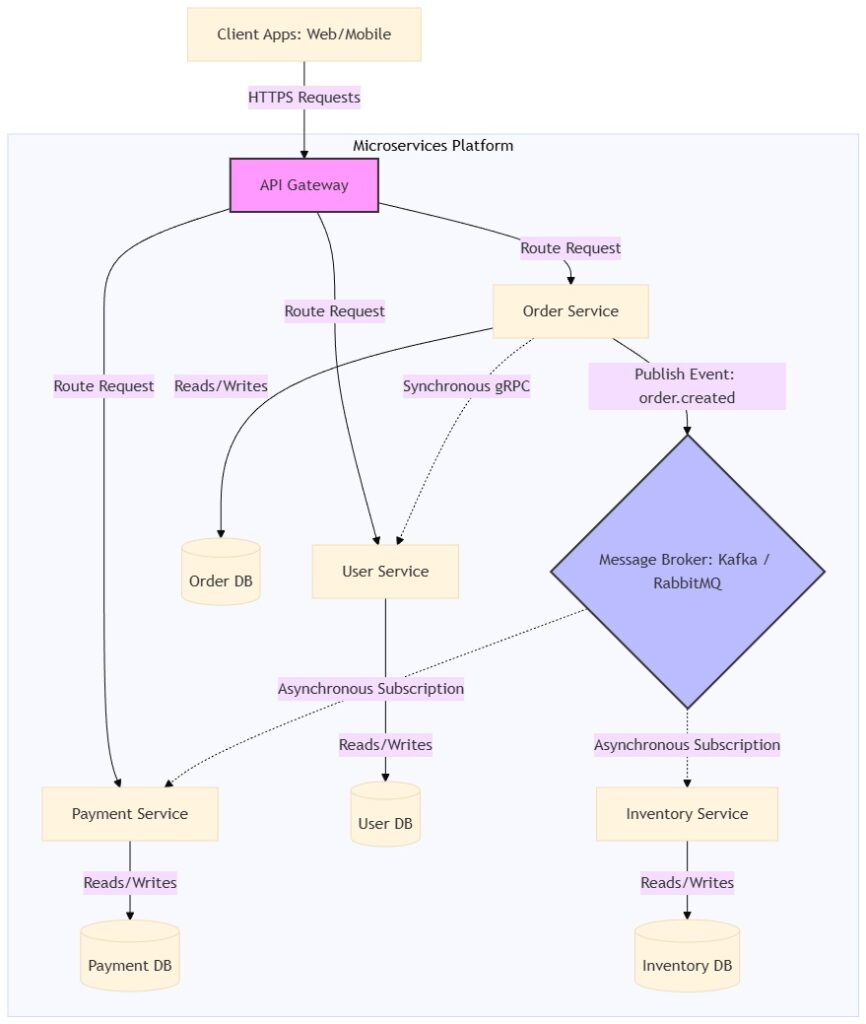
The diagram below shows how client requests flow through an API Gateway to independent, database-per-service microservices that communicate both synchronously and asynchronously.
Communication Models: Synchronous vs. Asynchronous
Microservices must communicate to fulfill complex workflows. You can choose between two main communication styles:
1. Synchronous Communication
In this model, a service sends a request and waits for a response before continuing.
- REST APIs (HTTP/JSON): These are simple, standardized, and easy to adopt. However, they add latency, and a chain of REST calls can slow down the entire system.
- gRPC (Google Remote Procedure Call): This framework uses protocol buffers to serialize data into a compact binary format. Consequently, gRPC delivers much higher throughput and lower latency, making it ideal for internal service-to-service communication.
2. Asynchronous Communication
In this model, services communicate using events without waiting for an immediate response.
- Event-Driven Messaging: A service publishes an event (e.g.,
order-created) to a message broker like Apache Kafka, RabbitMQ, or AWS SNS/SQS. Interested services subscribe to this event and process it independently. - Example: In an e-commerce platform, when a customer places an order, the
Order Servicepublishes anorder-createdevent. ThePayment,Inventory, andShippingservices consume this event and perform their jobs concurrently. Meanwhile, theOrder Serviceremains free to accept new orders immediately.
The Role of the API Gateway
An API Gateway acts as the single entry point for all external requests entering the system. It handles several cross-cutting concerns:
- Centralized Security: It manages authentication, SSL termination, and token validation (e.g., OAuth, JWT).
- Traffic Control: It distributes incoming traffic across service instances (load balancing) and enforces rate limiting to protect services from overload.
- Request Routing & Aggregation: It routes API calls to the correct microservices and can aggregate responses from multiple services into a single payload.
- Popular Tools: Kong, Nginx, Apigee, and AWS API Gateway.
Scaling Strategies in Microservices
Independent scaling is a major benefit of microservices. Because different services experience different loads, you can scale them selectively.
- Horizontal Scaling: Instead of buying larger servers (vertical scaling), you run multiple instances of a service and distribute traffic using load balancers.
- Auto-Scaling: Tools like Kubernetes or AWS ECS automatically add or remove service instances based on real-time metrics like CPU, memory, or request volume.
- Database Scaling: When databases become bottlenecks, you can use:
- Read Replicas: These handle read-heavy workloads by copying data from the primary database to read-only instances.
- Database Sharding: This partitions data across multiple databases using a shard key (like customer ID or region).
Managing Microservices Challenges and Trade-offs
While microservices offer incredible benefits, they redistribute complexity into the network. You must design for these challenges from day one:
1. Data Consistency (Eventual Consistency)
Since each service has its own database, you cannot use a single database transaction to keep everything synchronized. Instead, you must accept eventual consistency, where data updates propagate across services over time.
- The SAGA Pattern: This pattern manages distributed transactions by executing a series of local transactions. If one step fails, the system executes compensating transactions to undo the changes.
2. Observability and Debugging
A single request might travel through dozens of services. If an error occurs, finding the source is difficult.
- Distributed Tracing: Tools like OpenTelemetry, Jaeger, and Zipkin track request paths across services.
- Centralized Logging & Monitoring: Platforms use the ELK Stack (Elasticsearch, Logstash, Kibana) for logs, and Prometheus with Grafana for real-time metrics.
3. Security
Centralized security is not enough; you must protect every service boundary. Modern systems secure internal traffic using Mutual TLS (mTLS), token validation, and a Service Mesh (like Istio or Linkerd) to manage secure service-to-service communication.
Real-World Examples
Several tech giants have proven microservices at massive scale:
- Netflix: Handles millions of concurrent users by separating video streaming, recommendation engines, billing, and user profiles into individual services.
- Uber: Coordinates ride-matching, dynamic pricing, driver tracking, and payment processing through separate microservices to manage surges in peak demand.
- Amazon: Broke down its giant monolithic retail application into independent services (product search, cart, recommendations) so different teams could deploy updates faster.
Deployment Strategies
To update microservices safely, teams use advanced deployment strategies:
- Blue-Green Deployment: You run two identical environments. The “Blue” environment runs the active version, while the “Green” runs the new version. Once verified, you switch traffic instantly to Green.
- Canary Deployment: You roll out updates to a small percentage of users (e.g., 5%) first. If the update is stable, you gradually roll it out to the remaining users.