

 Ashish Sharma
No money? No problem! Help us pay the cloud hosting bills without opening your wallet—just give
this ad link a click!😉💸
In modern distributed systems, data constantly moves across networks, databases, caches, and microservices. However, a fundamental challenge exists: computer applications manage data using in-memory objects, whereas network sockets and storage systems only understand sequential streams of bytes.
To bridge this gap, developers rely on serialization. This article explains what serialization is, compares the most popular data exchange formats, and helps you choose the right format for your system architecture.
What is Serialization?
At its core, serialization is the process of converting an in-memory application object or data structure into a standardized, portable format. This format can be transmitted over a network or saved to persistent storage.
Conversely, deserialization is the reverse operation. It reconstructs the serialized byte stream back into a live in-memory object in the receiving application. Together, these processes act as a translation bridge, enabling services built with different programming languages and running on different platforms to exchange structured information seamlessly.

Common Serialization Formats
Choosing the right serialization format involves making trade-offs between human readability, processing speed, and payload size. Below, we examine the most common options used in modern software development.
1. JSON (JavaScript Object Notation)
JSON has become the industry standard for web applications and public APIs.
- Strengths: It is lightweight, text-based, highly readable, and supported by almost every programming language out there.
- Weaknesses: Because it is text-based, it produces larger payload sizes compared to binary alternatives. Additionally, parsing JSON introduces CPU overhead.
- Best For: Public-facing REST APIs, web apps, and configurations.
Example JSON Payload:
{
  "userId": 1024,
  "userName": "Alice Smith",
  "roles": ["admin", "developer"]
}
2. XML (eXtensible Markup Language)
XML was the dominant data exchange format before JSON gained popularity.
- Strengths: It supports rich metadata, nested hierarchies, and robust schema validation (via XSD).
- Weaknesses: Its tag-based structure makes it extremely verbose, which increases both storage footprints and network transit costs.
- Best For: Legacy enterprise systems (SOAP APIs) and configuration-heavy environments.
Example XML Payload:
<User>
  <UserId>1024</UserId>
  <UserName>Alice Smith</UserName>
  <Roles>
    <Role>admin</Role>
    <Role>developer</Role>
  </Roles>
</User>
3. Protocol Buffers (Protobuf)
Developed by Google, Protobuf is a highly optimized binary serialization format.
- Strengths: It uses a predefined schema (defined in
.protofiles) to compile data into a compact binary format. Consequently, it achieves fast serialization speeds and minimal payload sizes. - Weaknesses: The serialized data is not human-readable, meaning you need specialized debugging tools to inspect payloads.
- Best For: gRPC communication, high-throughput microservices, and internal service-to-service communication.
Example Protobuf Schema (user.proto):
syntax = "proto3";

message User {
  int32 user_id = 1;
  string user_name = 2;
  repeated string roles = 3;
}
4. Apache Avro
Avro is a row-oriented binary serialization framework commonly used in the big data space.
- Strengths: It couples the data payload directly with its JSON-defined schema. As a result, it excels at schema evolution, allowing fields to be added, renamed, or removed over time without breaking existing data pipelines.
- Weaknesses: Similar to Protobuf, it outputs non-readable binary streams, making manual inspection difficult.
- Best For: Apache Kafka message streaming, Apache Hadoop storage, and large-scale data pipelines.
5. BSON (Binary JSON)
BSON is a binary-encoded serialization of JSON documents.
- Strengths: It extends JSON’s data types to include dates, binary data, and integers, while indexing documents for faster database queries.
- Weaknesses: In some cases, BSON payloads can actually be slightly larger than raw JSON due to extra metadata headers.
- Best For: Document-oriented databases like MongoDB.
Serialization Formats at a Glance
The following table summarizes the key characteristics of each serialization format:
| Format | Human Readable | Schema Required? | Data Size | Encoding/Decoding Speed | Common Use Case |
|---|---|---|---|---|---|
| JSON | Yes | No | Medium | Moderate | Web APIs, RESTful Services |
| XML | Yes | Optional | Large | Slow | SOAP APIs, Legacy Systems |
| Protobuf | No | Yes | Small | Very Fast | gRPC, Microservices |
| Avro | No | Yes | Small | Very Fast | Big Data (Kafka, Hadoop) |
| BSON | No | No | Medium | Fast | MongoDB Storage & Queries |
Architectural Use-Case Scenarios
To visualize how these formats function in a real-world system, let’s explore a typical microservice architecture:
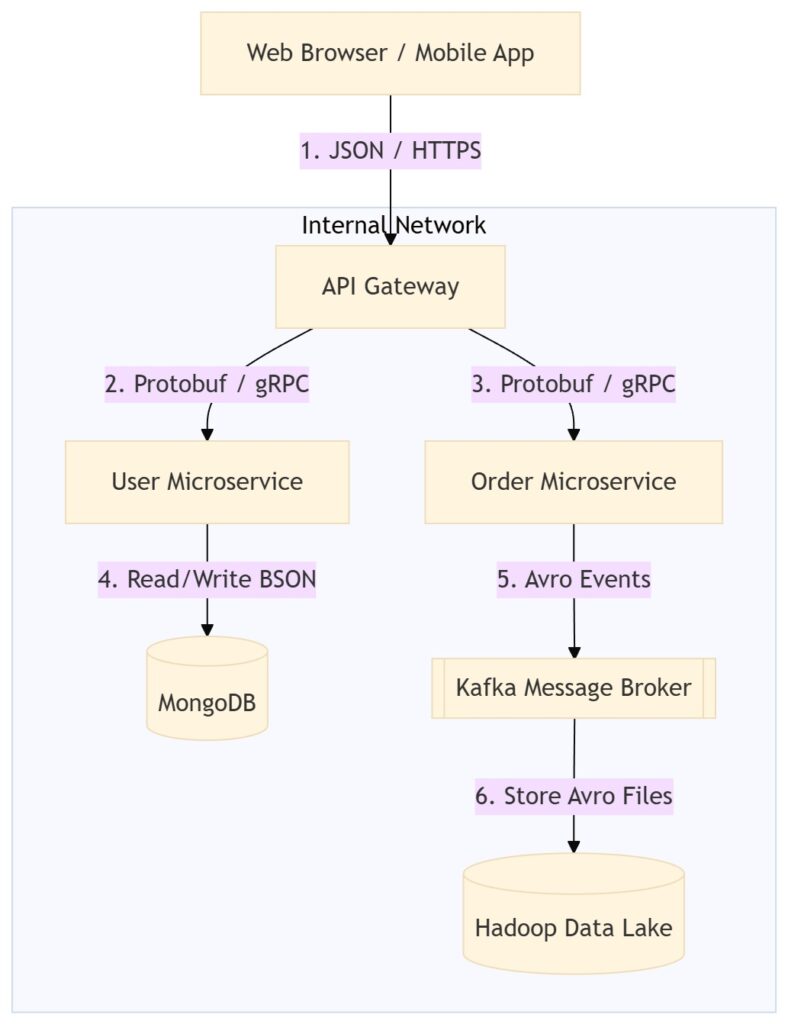
Why this architecture makes sense:
- Public APIs use JSON: The client-to-gateway connection requires maximum interoperability and easy debugging, making JSON the clear winner.
- Internal Microservices use Protobuf: Inside the private network, service-to-service communication requires high speed and low latency. Thus, using gRPC and Protobuf reduces network overhead.
- Database uses BSON: MongoDB stores data as BSON to support flexible schemas while accelerating query execution and indexing.
- Data Streams use Avro: The data pipeline passes messages through Kafka to Hadoop using Avro. This guarantees schema validation and ensures that downstream analytics jobs do not crash when the order schema changes.
Balancing the Core Trade-Offs
When selecting a format for your application, you must balance three competing architectural concerns:
- Readability vs. Efficiency: Developers easily debug JSON and XML. However, binary formats like Protobuf reduce bandwidth costs and CPU usage, making them ideal when requests scale into millions.
- Schema Enforcement: Text formats like JSON allow flexible schemas but can lead to run-time errors if a client sends malformed data. In contrast, Protobuf and Avro enforce strong types compile-time or schema-time, ensuring system robustness.
- Compatibility and Evolution: As systems grow, data structures change. Avro and Protobuf explicitly handle backward and forward compatibility, allowing old services to read data generated by newer services and vice versa.
Security Risks: Insecure Deserialization
Implementing serialization carries security responsibilities. Insecure deserialization occurs when an application deserializes untrusted or tampered data without proper validation.
The Threat
Attackers can craft malicious payloads that abuse the deserialization process to execute arbitrary code (Remote Code Execution), trigger Denial of Service (DoS) attacks by exhausting memory, or bypass authentication checks.
Best Mitigation Practices
- Never deserialize untrusted payloads without validating inputs.
- Use digital signatures or HMACs to verify that the serialized data has not been modified in transit.
- Prefer strict binary schemas (like Protobuf) over general-purpose object serialization (like Python’s
pickleor Java’s native serialization), which are inherently more prone to exploitation. - Keep dependencies updated to patch known vulnerabilities in JSON or XML parsing libraries.
Key Takeaways
- Serialization enables portability by converting complex, in-memory application objects into standard data streams.
- No format is universally superior. You must select a format based on your specific requirements: JSON for web APIs, Protobuf for high-performance microservices, and Avro for large-scale data pipelines.
- Understand the trade-offs between human readability, payload sizes, processing speeds, and long-term schema compatibility.
- Prioritize security by treating all incoming serialized data as untrusted to protect your system from insecure deserialization attacks.