 Ashish Sharma
Introduction: The Modern Data Deluge
No money? No problem! Help us pay the cloud hosting bills without opening your wallet—just give
this ad link a click!😉💸
Every modern software system generates data around the clock. Every tap on a smartphone, API call, credit card swipe, IoT temperature check, server metric, and video upload writes records to storage.
For decades, software engineers relied on centralized Relational Database Management Systems (RDBMS). However, as organizations expanded globally, data volumes surged past the processing boundaries of single-machine servers.
                             [ THE DATA SURGE ]
+-------------------+     +---------------------+     +----------------------+
| 100K Users        |     | 10M Connected IoT   |     | Global Streaming     |
| Clickstream Events| --> | Telemetry Sensors   | --> | & Financial Systems  |
+-------------------+     +---------------------+     +----------------------+
                                     |
                                     v
                       [ Traditional RDBMS Collapses ]
                        - Disk space exhausted
                        - CPU & Memory saturated
                        - Write locks trigger timeouts
When datasets grow to terabytes and petabytes, storing bytes is only the first hurdle. Engineering teams must ingest data instantly, query it concurrently, maintain data integrity, and extract business intelligence without inflating cloud infrastructure bills.
Big Data describes datasets whose size, ingestion velocity, and structural complexity outstrip traditional database capabilities. To manage this reality, the industry shifted toward distributed storage, parallel computing, and decoupled lakehouse architectures.
Defining Big Data: The 6 Vs Framework
Engineers evaluate data complexity using the 6 Vs framework. While initial industry definitions focused on three or five dimensions, modern enterprise architectures require all six:
| Dimension | Architectural Meaning | Practical Enterprise Example |
|---|---|---|
| 1. Volume | The absolute scale of raw data collected over time. | Social networks like Meta ingesting over 4 Petabytes of new data daily. |
| 2. Velocity | The speed at which incoming data arrives and requires handling. | Algorithmic trading desks processing millions of order events per second. |
| 3. Variety | The diverse range of structured, semi-structured, and unstructured data formats. | Combining SQL tables, JSON payloads, sensor metrics, MP4 video streams, and Parquet files. |
| 4. Veracity | The trustworthiness, cleanliness, and accuracy of incoming records. | Resolving missing sensor telemetry readings, eliminating duplicate records, and validating schemas. |
| 5. Value | The actionable business return on investment (ROI) extracted from processed data. | Converting raw browsing logs into personalized product recommendations that lift conversions. |
| 6. Variability | The unpredictability of data rates, meaning shifts, and schema changes over time. | Black Friday retail traffic spikes or changes in seasonal consumer purchase habits. |
Why Traditional Relational Databases Fail at Scale
For decades, database scaling meant vertical scaling (scaling up): purchasing a larger server with faster CPUs, additional RAM, and larger NVMe arrays. At internet scale, this strategy hits hard physical and economic limits.
     VERTICAL SCALING (Scale-Up)              HORIZONTAL SCALING (Scale-Out)
     [ Single High-End Server ]                [ Many Commodity Servers ]
   +----------------------------+        +---------+  +---------+  +---------+
   |   Expensive Mainframe/Box  |        | Node 1  |  | Node 2  |  | Node 3  |
   | CPU: 128 Core | RAM: 2 TB  |  vs.   +---------+  +---------+  +---------+
   |   Single Point of Failure  |        +---------+  +---------+  +---------+
   |   Hardware ceiling reached |        | Node 4  |  | Node 5  |  | Node N  |
   +----------------------------+        +---------+  +---------+  +---------+
                                         Elastic, fault-tolerant, cost-effective
1. Vertical Scaling Limits
Eventually, hardware manufacturers cannot build a machine large enough to hold an organization’s working dataset. When a database requires petabytes of storage, single-node architectures reach a hard stop.
2. High Concurrency and Performance Bottlenecks
RDBMS engines rely on ACID guarantees via table locks, row locks, and write-ahead logs. When tens of thousands of client threads write simultaneously, lock contention spikes, latencies increase, and the database stalls. Furthermore, complex multi-table joins across hundreds of millions of rows saturate memory.
3. Rigid Schemas
Relational engines demand predefined, rigid schemas. When incoming payloads change frequently—such as dynamic telemetry payloads from hundreds of distinct IoT device models—updating schema definitions across live database tables creates maintenance downtime.
4. Exponential Hardware Costs
Top-of-the-line enterprise servers cost exponentially more than entry-level machines. Purchasing custom multi-terabyte RAM systems delivers diminishing returns compared to pooling commodity hardware.
5. Fragile Fault Tolerance
Traditional servers treat hardware failure as an emergency. If a server’s RAID controller or motherboard fails, the entire database goes offline until standby failover completes. In contrast, modern distributed systems assume hardware components will fail continuously and build automated data replication directly into their software layers.
Common Big Data Workloads and Use Cases
Organizations implement big data architectures to power four primary workload profiles:
[ Application Logs & Events ] --> IT Security, Observability, SIEM Auditing
[ User Clickstream Trails   ] --> Behavioral Tracking, Funnel Optimization, A/B Testing
[ Real-Time IoT Telemetry   ] --> Predictive Maintenance, Smart Fleet Telematics
[ Machine Learning Pipelines] --> Model Training, Feature Stores, Real-Time Inference
1. Application Logs and Event Traces
Every distributed microservice, API gateway, container cluster, and firewall continuously produces system logs. Security and DevOps teams aggregate these events across thousands of instances to monitor health, trace latency spikes, and detect cyber threats.
2. Clickstream Analytics
E-commerce and SaaS platforms capture every mouse click, page scroll, cart update, and search query. Analytics teams process this clickstream to build behavioral models, discover conversion drop-offs, and power real-time personalization algorithms.
3. Industrial IoT and Telemetry
Factories, wind farms, modern vehicles, and medical devices transmit continuous metrics. Processing this telemetry in real time enables predictive maintenance—detecting abnormal vibrations in a turbine bearing days before catastrophic failure.
4. Machine Learning and AI Training
Deep learning models require massive historical training corpora. Engineers build big data pipelines to clean, normalize, tokenize, and transform petabytes of unstructured text, audio, and tabular data into training checkpoints and feature stores.
Processing Paradigms: Batch Processing vs. Stream Processing
Transforming raw bytes into actionable decisions requires choosing between two processing engines: Batch and Stream.
BATCH PROCESSING:
[ Data Source ] --> Accumulate Over Time (Hours/Days) --> [ Run Spark Job ] --> [ Output ]
(Optimized for high throughput & complex aggregations; Latency: Minutes to Hours)
STREAM PROCESSING:
[ Data Source ] --> Emit Event --> [ Flink / Kafka Streams ] --> Instant Action / Alert
(Optimized for low latency & real-time responsiveness; Latency: Milliseconds)
| Feature | Batch Processing | Stream Processing |
|---|---|---|
| Data Scope | Fixed chunks or historical datasets over specific windows. | Unbounded continuous event streams arriving per millisecond. |
| Latency | Minutes, hours, or overnight runs. | Milliseconds to single-digit seconds. |
| Throughput | High; maximizes data volume per run. | Continuous, event-by-event or micro-batch processing. |
| Typical Tools | Apache Spark, Hadoop MapReduce, AWS Glue. | Apache Flink, Kafka Streams, Spark Structured Streaming. |
| Primary Use Cases | Nightly financial reconciliations, payroll, ML model retraining. | Credit card fraud detection, live system alerting, stock trading engines. |
Case Study: Financial Fraud Detection
Consider credit card fraud detection. A bank cannot wait for a nightly batch job to process transactions because the thief will have emptied the account within minutes.
Instead, the architecture adopts a hybrid pattern:
- Stream Processing (The Gatekeeper): An in-memory stream processor (such as Apache Flink or Kafka Streams) inspects every transaction against rule sets and lightweight machine learning models within 50 milliseconds. If an account registers a swipe in New York and another in London 10 minutes later, the stream processor blocks the transaction immediately.
- Batch Processing (The Brain): Overnight, Apache Spark processes millions of historical transactions to retrain the neural network, update customer risk scores, and generate regulatory compliance reports.
Modern Storage Evolution: HDFS vs. Cloud Object Storage (S3) vs. Delta Lake
Big data storage has evolved across three distinct generations over the past two decades:
GEN 1: Hadoop HDFS                 GEN 2: Cloud Object Storage (S3)       GEN 3: Lakehouse (Delta Lake)
+-------------------------+        +------------------------------+       +------------------------------+
| [Compute + Storage]     |        | [Decoupled Storage: AWS S3]  |       | [ACID + Versioned Storage]   |
| Combined on same nodes  |  --->  | Compute scales independently | --->  | S3/ADLS + Parquet + Metadata |
| On-premise maintenance  |        | Lower costs, serverless      |       | Schema Enforcement & Time Trv|
+-------------------------+        +------------------------------+       +------------------------------+
1. HDFS (Hadoop Distributed File System)
HDFS distributes data across standard physical disk drives in a dedicated rack cluster, replicating each data block across multiple nodes (typically 3x).
- Strengths: Co-locates compute and storage to prevent network saturation on local networks. Delivers high read throughput for on-premises clusters.
- Weaknesses: Pairs compute nodes with storage disks. If an organization needs more storage without extra compute, it must purchase expensive servers anyway. Maintaining HDFS namenodes requires significant operational overhead.
2. S3 (Amazon Simple Storage Service) & Cloud Object Stores
Cloud object storage decoupled compute from storage permanently. Compute clusters (like AWS EMR or Databricks) spin up on demand, query S3, and terminate immediately when jobs finish.
- Strengths: Near-infinite scalability, 99.999999999% (11 9’s) durability, zero server management, and cold data tiering.
- Weaknesses: Standard object storage does not offer native row-level updates, point-in-time rollbacks, or atomic transactions across multi-file operations.
3. Delta Lake: Bringing ACID Guarantees to Object Stores
To address object store limitations, modern data engineering relies on table storage layers such as Delta Lake, Apache Iceberg, and Apache Hudi. Delta Lake sits on top of cloud storage (S3, ADLS, GCS) and structures underlying Parquet files using an atomic transaction log.
- ACID Transactions: Eliminates dirty reads and partial file writes when pipeline jobs fail halfway through execution.
- Schema Enforcement: Prevents bad data ingestion by rejecting records that do not match the expected table schema.
- Time Travel & Auditing: Allows data engineers to query point-in-time historical data snapshots and roll back accidental updates or deletes.
- Compaction (Z-Ordering): Merges tiny JSON or Parquet files into optimized 1GB files, accelerating query performance in engines like Trino and Spark.
End-to-End Reference Architecture: Ingesting Terabytes of Daily Logs
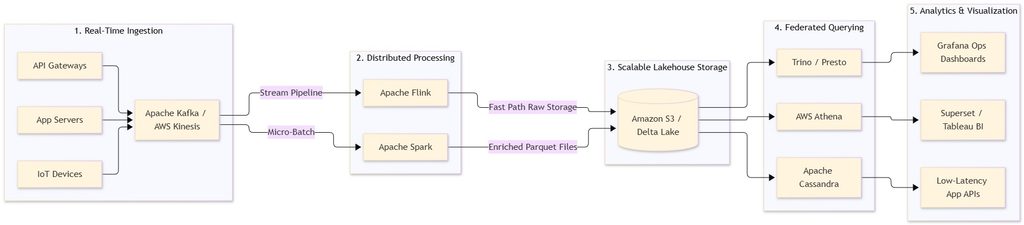
The following production-ready architecture illustrates how an enterprise ingests, processes, stores, and serves terabytes of operational log events daily:
Step-by-Step Pipeline Mechanics
- Ingestion Layer: Edge application pods, microservices, and network devices ship JSON log lines to an Apache Kafka cluster or AWS Kinesis. This decouples client systems from downstream analytics processors, buffering incoming spikes during traffic surges.
- Processing Layer:
- Stream Processing (Apache Flink): Flink reads events straight from Kafka brokers with millisecond latency, filtering for critical error conditions (e.g., HTTP
500status floods, unauthorized intrusion attempts) and updating live metrics. - Batch Processing (Apache Spark): Spark pulls accumulated log blocks, runs sessionization algorithms, enriches records with geolocation metadata, and performs deduplication.
- Stream Processing (Apache Flink): Flink reads events straight from Kafka brokers with millisecond latency, filtering for critical error conditions (e.g., HTTP
- Storage Layer (Delta Lake on Amazon S3): Spark commits cleansed records as columnar Parquet files into a partitioned Delta Lake storage tier. Delta Lake’s transaction log enforces schema consistency and handles automatic file compaction.
- Querying Layer (Trino / Presto / Athena): Instead of loading raw data into dedicated data warehouses, distributed SQL engines (Trino or Presto) execute federated ad-hoc SQL queries directly against Delta Lake tables in parallel. Meanwhile, frequently accessed hot lookups write to Apache Cassandra for millisecond key-value retrieval.
- Consumption Layer: Data analysts connect business intelligence tools like Tableau or Apache Superset for reporting, while Site Reliability Engineers (SREs) track production metrics using live Grafana dashboards.
Technology Selection Matrix
Use this quick-reference matrix when selecting big data tools for your production tech stack:
| Component Category | Recommended Frameworks | Primary Selection Criteria |
|---|---|---|
| Distributed Message Bus | Apache Kafka, AWS Kinesis | High-throughput, durable streaming log buffers. Kafka leads for open-source and multi-cloud setups; Kinesis fits native AWS cloud architectures. |
| Distributed Compute (Batch) | Apache Spark, Ray | Large-scale data transformations, distributed machine learning pipelines, and extract-transform-load (ETL) routines. |
| Distributed Compute (Stream) | Apache Flink, Kafka Streams | Low-latency stateful event processing, real-time windowing, complex event processing, and instant anomaly alerting. |
| Scalable Storage Layer | Delta Lake, Apache Iceberg | Cloud-native data lake architectures requiring ACID transactions, historical time-travel, and schema validation on top of S3/ADLS. |
| Interactive Query Engines | Trino (Presto), AWS Athena | High-speed, interactive SQL queries directly against object storage without needing to load data into a proprietary warehouse. |
| Distributed NoSQL Stores | Apache Cassandra, MongoDB | Fast writes and single-digit millisecond point lookups for semi-structured documents and real-time application counters. |
Key Architectural Takeaways
- Big data transcends file size: Complexity stems from the interplay of Volume, Velocity, Variety, Veracity, Value, and Variability.
- Horizontal scaling always triumphs at scale: Upgrading single machines delivers diminishing economic and technical returns; modern architectures pool commodity cloud instances.
- Decoupled compute and storage is the gold standard: Separating compute engines (Spark/Flink) from storage tiers (S3/Delta Lake) slashes operational costs and maximizes elasticity.
- Match latency to the business problem: Use stream processing when milliseconds matter (fraud detection, real-time telemetry alerts); use batch processing when thorough, high-volume historical analysis is required (reporting, model training).
- Data lakes have grown up: Modern lakehouse formats like Delta Lake bridge the gap between traditional data warehouses and low-cost object stores by bringing ACID guarantees, schema validation, and time travel to distributed object stores.