

 Ashish Sharma
No money? No problem! Help us pay the cloud hosting bills without opening your wallet—just give
this ad link a click!😉💸
Have you ever wondered how a website remembers you are logged in, keeps items in your shopping cart, or saves your preferences as you navigate from page to page?
The magic behind this seamless experience is session management. In this guide, we will break down how web sessions work, explore the techniques developers use to manage state, and compare the two dominant approaches: Session-Based and Token-Based authentication.
The Core Challenge: HTTP is Stateless
To understand sessions, we must first understand the underlying protocol of the web: HTTP (Hypertext Transfer Protocol).
HTTP is fundamentally stateless. This means each request sent from your browser to a server is a completely independent interaction. The server treats every request as if it is coming from a brand-new visitor, retaining no built-in memory of previous requests.
┌─────────┐   Request 1: "Log me in"      ┌────────┐
│         ├──────────────────────────────>│        │
│         │   Response 1: "Welcome!"      │        │
│ Client  │<──────────────────────────────┤ Server │
│ (User)  │   Request 2: "Show my cart"   │        │
│         ├──────────────────────────────>│        │
│         │   Response 2: "Who are you?"  │        │
└─────────┘<──────────────────────────────┴────────┘
Without a state-management mechanism:
- You would have to re-authenticate (log in) on every single page.
- Your shopping cart would empty the moment you clicked to check out.
- The web would be frustrating and impractical to use.
While statelessness allows the web to scale incredibly well (since servers do not need to hold memory for millions of concurrent users), developers must bridge the gap using session management to create a stateful user experience.
Techniques for Maintaining State
Developers primarily use two models to maintain state across HTTP: Session-Based Authentication (Stateful) and Token-Based Authentication (Stateless).
Here is a look at both architectures.
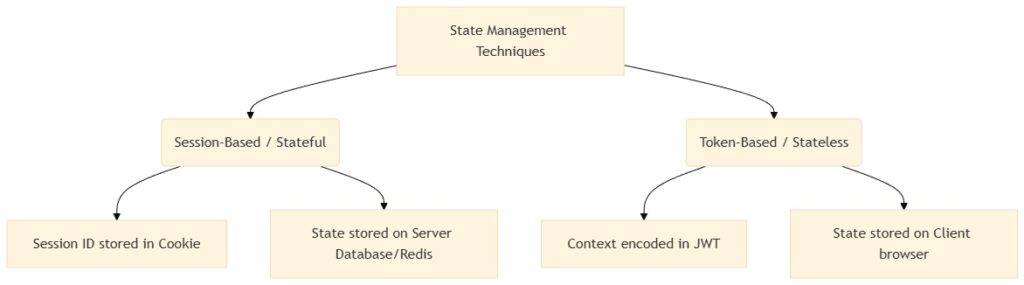
Session-Based Authentication (Stateful)
In the session-based model, the server owns and manages the session state.
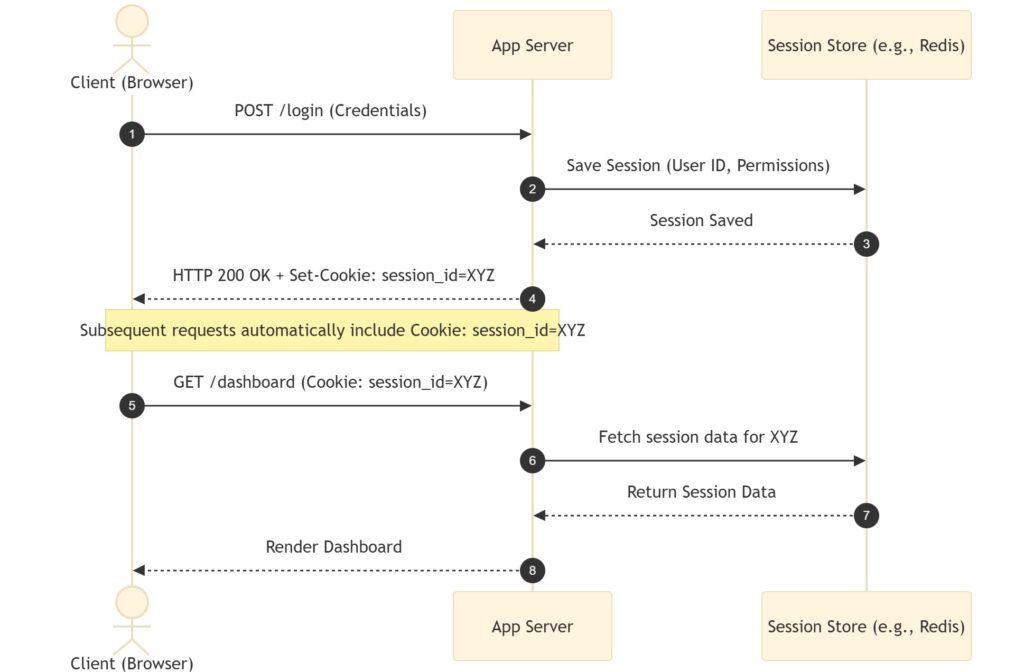
How It Works:
- The user logs in with their credentials.
- The server verifies the credentials, creates a session record (in memory or a database), and generates a unique Session ID.
- The server sends this Session ID back to the browser in a HTTP response header called
Set-Cookie. - The browser automatically stores this cookie and attaches it to every subsequent request to that domain.
- The server reads the Session ID from the incoming cookie, retrieves the corresponding session data from its storage, and customizes the response.
Analogy:
Think of the session cookie as a claim ticket at a coat check. The heavy coat (the user data) stays secure on the server side, while you only carry a tiny ticket (the Session ID) to retrieve it.
Use Case Scenario:
- Traditional Web Portals: Best for monoliths and applications where the backend handles both logic and page rendering (e.g., Spring Boot, Ruby on Rails, Django apps) and requires instant session revocation capability.
Token-Based Authentication (Stateless)
Token-based authentication moves the responsibility of storing state from the server to the client.
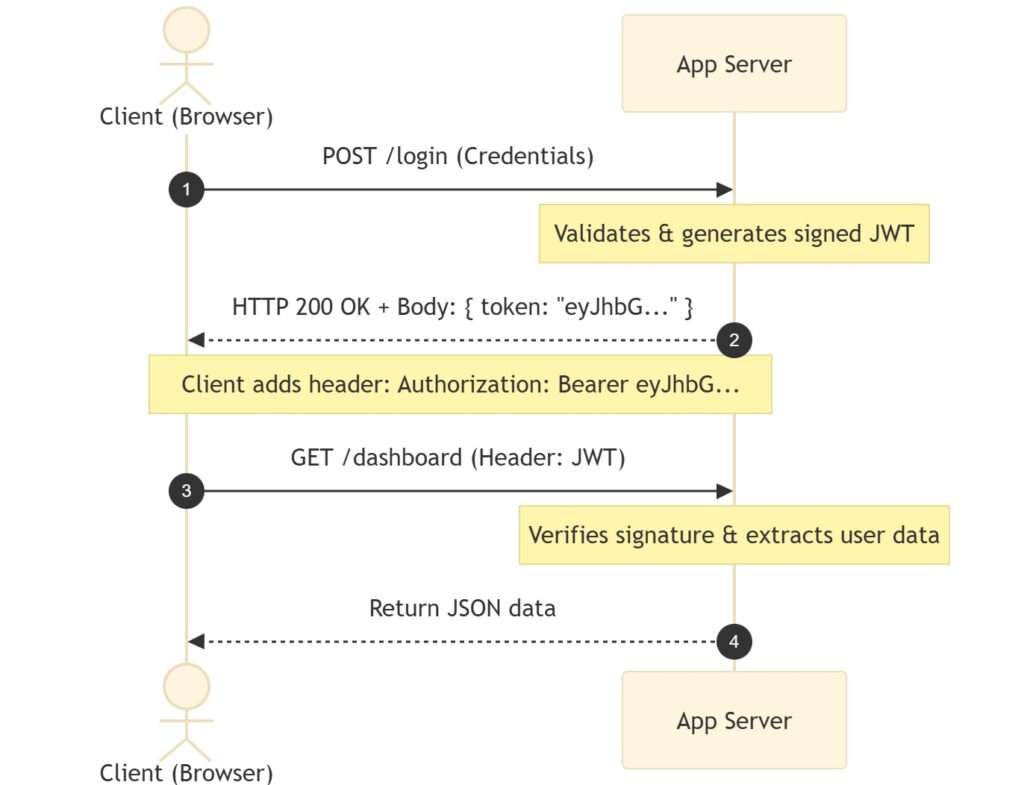
How It Works:
- The user logs in with their credentials.
- The server verifies the credentials and packages the user’s identity, roles, and expiration time into a self-contained token, usually a JSON Web Token (JWT).
- The server signs this token with a secret key and returns it to the client.
- The client stores the token (typically in
LocalStorageor a secure cookie) and manually attaches it to subsequent requests, usually inside theAuthorizationheader (Bearer <token>). - When a request arrives, the server verifies the digital signature of the token. If the signature is valid, the server trusts the data inside the token without performing a database lookup.
Analogy:
Think of a JWT as a signed digital passport. The passport contains your details and is stamped by a trusted authority. Any border control (server) can verify the stamp’s authenticity without calling your home country’s database.
Use Case Scenario:
- Microservices and APIs: Ideal for modern single-page applications (SPAs) built with React/Vue communicating with multiple backend services. A single token can be verified by dozens of independent microservices without hitting a central session database.
Stateful vs. Stateless: Side-by-Side Comparison
| Feature | Session-Based (Stateful) | Token-Based (Stateless) |
|---|---|---|
| Storage Location | Server (Memory, DB, or Cache) | Client (Browser storage/Cookies) |
| Scalability | Harder (requires sharing session state across servers) | Easier (naturally stateless, scale horizontally) |
| Security | Highly secure; session data never leaves the server | Risk of theft (XSS/CSRF) if client storage is unsecured |
| Performance | Database/Cache lookup overhead on every request | Instant local cryptographic validation (no DB lookups) |
| Session Revocation | Easy (delete the session record on the server) | Hard (tokens remain valid until they naturally expire) |
| Primary Use Case | Traditional monolithic web applications | APIs, Microservices, and Mobile Applications |
Best Practices for Scaling Session Management
As application traffic grows, managing session state across multiple servers becomes an architectural bottleneck. Here is how to scale state management:
- Sticky Sessions (Session Affinity): A load balancer routes a user’s requests to the exact same server that created their session. However, this creates uneven server loads and fails if a server goes down.
- Distributed Session Stores (Recommended): Store sessions in a fast, in-memory cache like Redis or Memcached. This setup allows any server in your fleet to handle a request by fetching the session data from the shared cache in milliseconds.
- Stateless JWTs: By shifting to signed tokens, you completely eliminate the need for server-side lookup databases, freeing up resources and allowing seamless horizontal scaling.
Critical Security Concerns and Mitigations
Since sessions govern authentication boundaries, they are major targets for attackers.
1. Session Hijacking
- The Threat: Attackers steal a valid Session ID to impersonate a user.
- The Mitigation: Enforce HTTPS to prevent interception, implement short-lived sessions, and rotate Session IDs upon privilege escalation (e.g., after logging in).
2. Cross-Site Request Forgery (CSRF)
- The Threat: Malicious sites trick a user’s browser into making unauthorized requests to an app where they are currently authenticated.
- The Mitigation: Use CSRF validation tokens and set cookie attributes properly.
3. Securing Cookies
Always configure session and token cookies with these three security flags:
Secure: Forces the browser to send cookies only over encrypted HTTPS connections.HttpOnly: Prevents JavaScript from reading the cookie, shielding it from Cross-Site Scripting (XSS) attacks.SameSite=LaxorStrict: Restricts when cookies are sent with cross-site requests, mitigating CSRF risks.
Web Sessions: Important Interview Q&As
Q1: Why is HTTP considered a stateless protocol?
Answer: HTTP is stateless because each request from a client is processed as an isolated transaction. The server does not retain context or memory of previous requests from the same client, which simplifies server design but requires external state management.
Q2: How do server-side sessions and client-side tokens differ in scalability?
Answer: Server-side sessions require a backend data store (like Redis) or session replication across instances, which adds architectural complexity at scale. Client-side tokens (JWTs) are self-contained and cryptographically verified, allowing servers to scale horizontally without sharing session data.
Q3: When should you avoid using JWTs for session management?
Answer: Avoid JWTs when your application requires immediate session revocation (e.g., force logouts, blocking users immediately). Because JWTs are stateless, they remain valid until they expire unless you build a complex blocklist database, which defeats their stateless advantage.
Q4: What is the purpose of the HttpOnly flag on a cookie?
Answer: The HttpOnly flag prevents client-side scripts (JavaScript) from accessing the cookie. This is a critical security measure that prevents attackers from stealing session tokens using Cross-Site Scripting (XSS) attacks.
Q5: How does a distributed system using microservices handle user sessions?
Answer: Microservices usually leverage a centralized identity provider (IdP) to issue a signed JWT. Each individual microservice validates the token’s cryptographic signature locally using public keys, allowing decentralized authorization without querying a central database for every API request.