

 Ashish Sharma
What Is Scalability?
Every growing business faces a critical milestone: user traffic increases, transactions surge, and existing servers begin to strain under the pressure. A system that seamlessly serves 1,000 users can suddenly buckle when 100,000 or 1,000,000 users arrive at the same time.
At its core, scalability measures a system’s ability to handle growing workloads gracefully without sacrificing performance, reliability, or user experience.
                                Scalability Test

       Normal Load (1K Users)                    Peak Load (1M Users)
   ┌─────────────────────────────┐        ┌─────────────────────────────┐
   │  Response Time:  < 100 ms   │        │  Response Time:  < 120 ms   │
   │  Availability:   99.99%     │   ──>  │  Availability:   99.99%     │
   │  Architecture:   Stable     │        │  Architecture:   Intact     │
   └─────────────────────────────┘        └─────────────────────────────┘
                ▲                                        ▲
                └────── Same Consistent User Experience ─┘
Scalability extends far beyond simply adding raw capacity. For instance, if your platform processes ten times more requests tomorrow, your users still expect sub-second page loads. Furthermore, your services must maintain high availability without forcing your engineering team to rewrite the entire codebase.
Consequently, system architects evaluate designs with one core question in mind: “What happens when demand multiplies by 10x, 50x, or 100x?” If response times degrade, infrastructure costs explode, or databases crash, the system lacks true scalability.
Why Do Systems Need to Scale?
Systems rarely crash under predictable, everyday workloads. Instead, they falter when unanticipated surges overload key components. Below are four common drivers that demand proactive scaling:
- Exponential User Growth: A startup might launch in a single city, but global adoption brings millions of concurrent connections across different time zones.
- Relentless Data Ingestion: Modern software applications continuously produce audit logs, telemetry, behavioral analytics, payment records, and IoT data streams. Over time, storing and querying terabytes or petabytes of data creates massive storage and retrieval bottlenecks.
- Unpredictable Traffic Surges: Seasonal events—such as Black Friday sales, flash promotions, viral social posts, or concert ticket launches—generate traffic spikes within seconds. These spikes quickly expose hidden architectural bottlenecks.
- Strict SLA Commitments: Most enterprise organizations guarantee strict uptime and response-time Service Level Agreements (SLAs). Therefore, building scalable systems protects business revenue, user trust, and brand reputation.
Exploring the Three Scaling Strategies
Architects fundamentally leverage three paths to scale an application: Vertical Scaling, Horizontal Scaling, and Diagonal Scaling.
1. Vertical Scaling (Scaling Up)
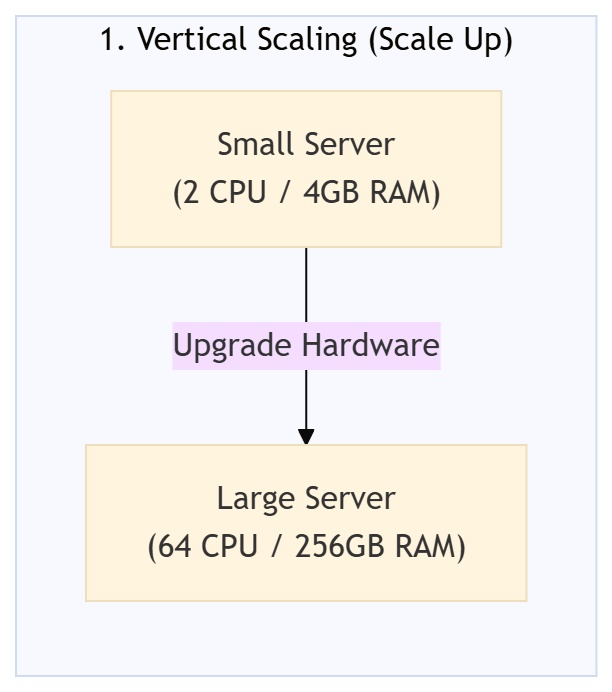
Vertical scaling increases the capacity of a single physical or virtual machine by adding more CPU cores, RAM, solid-state storage, or network bandwidth.
- How It Works: Rather than altering the underlying code, you upgrade the host machine (for example, moving an AWS EC2 instance from
t3.mediumtoc6i.8xlarge). - Advantages:
- It requires zero architectural modifications.
- It maintains a single application state without distributed networking overhead.
- Your deployment pipeline remains straightforward.
- Disadvantages:
- Every machine hits physical hardware limits.
- High-spec servers become exponentially expensive.
- A single server remains a single point of failure (SPOF).
2. Horizontal Scaling (Scaling Out)
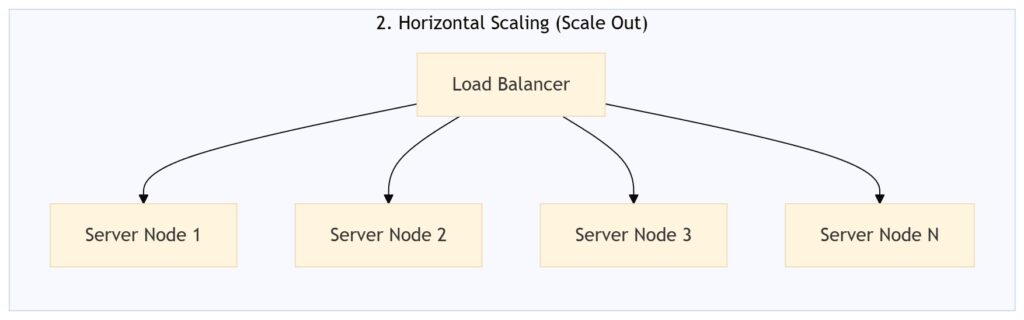
Horizontal scaling distributes the computational workload across multiple servers working in concert.
- How It Works: You place a fleet of stateless application servers behind a load balancer. As traffic climbs, the load balancer distributes incoming network packets evenly across the pool.
- Advantages:
- It unlocks near-infinite growth potential.
- It delivers superior fault tolerance; if one node crashes, other healthy nodes handle the traffic.
- It leverages cost-effective, off-the-shelf commodity hardware.
- Disadvantages:
- It introduces distributed system complexities, such as data replication, eventual consistency, and inter-service network latency.
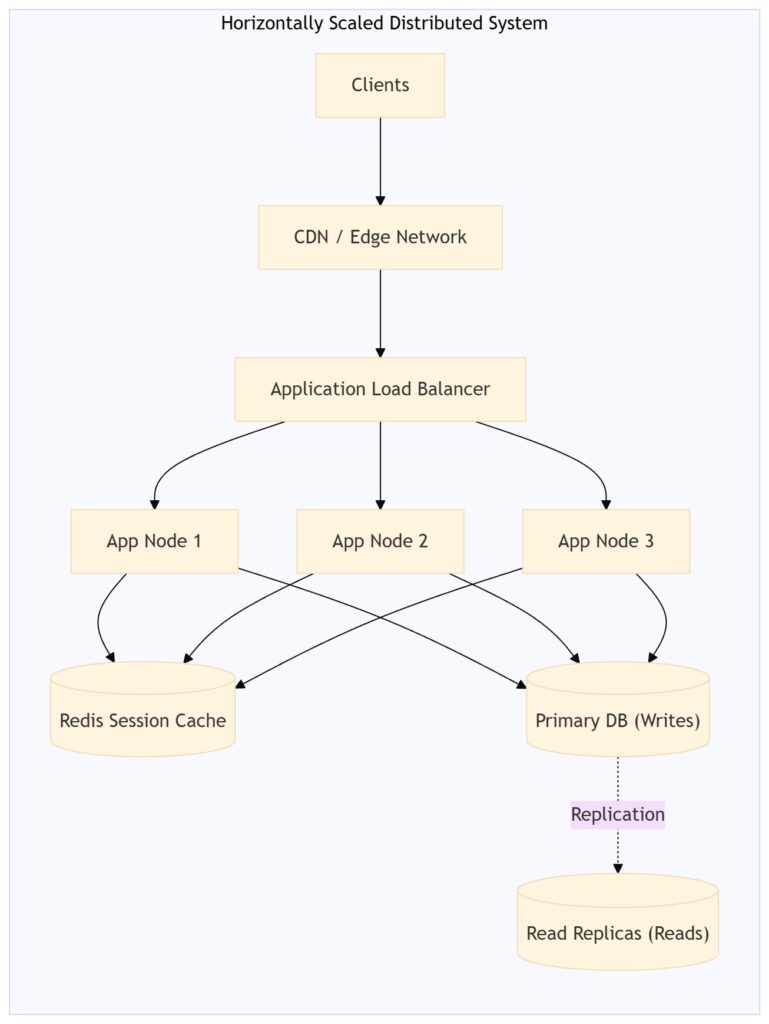
- It requires state management tools (like Redis or Memcached) to handle user sessions.
3. Diagonal Scaling (The Hybrid Approach)
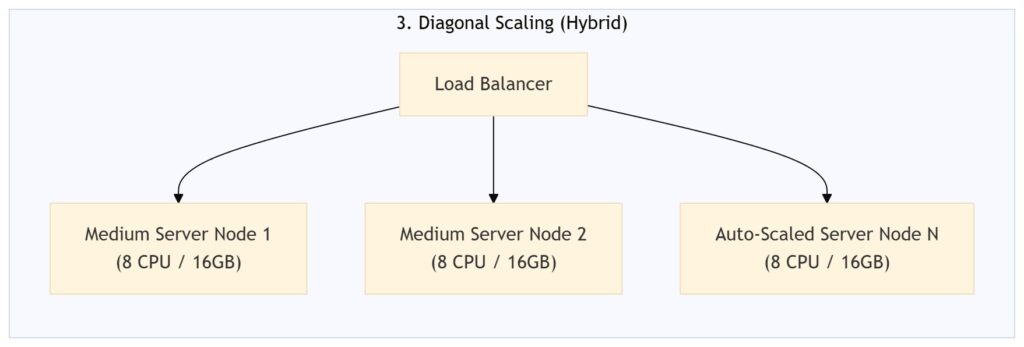
Diagonal scaling blends the immediate simplicity of vertical scaling with the elasticity of horizontal scaling.
- How It Works: Teams initially upgrade their single server or database to a reasonably powerful tier to handle baseline requirements comfortably. Subsequently, when traffic increases further, they replicate these right-sized servers horizontally behind a dynamic load balancer or cloud auto-scaling group.
- Advantages:
- It buys engineering time during early growth phases.
- It optimizes cloud infrastructure costs by avoiding oversized virtual machines.
- Modern container platforms (like Kubernetes) and serverless environments naturally embody this strategy.
Architectural Comparison: Single Node vs. Distributed Tier
The diagram below illustrates how an application transitions from a vertically scaled single node to a horizontally distributed system:
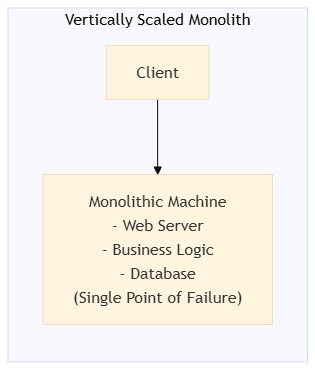
Common Challenges in Scaling and Practical Solutions
Scaling brings its own operational side effects. Understanding these bottlenecks early helps engineers build robust systems:
| Challenge | Root Cause | Practical Solution |
|---|---|---|
| Increased Latency | Sequential API calls, remote database hops, and cross-datacenter round-trips add delay. | Deploy in-memory caches (Redis), implement CDNs for static assets, and run asynchronous worker queues. |
| Database Bottlenecks | Read/write locks, slow queries, and single-node transaction limits choke performance. | Separate reads and writes using Read Replicas, shard relational tables, or adopt NoSQL databases. |
| Downtime & Blast Radius | Multiple interconnected services increase potential points of system failure. | Introduce health checks, auto-healing clusters, canary deployments, and circuit breakers. |
| Session & State Drifting | Horizontally distributed nodes cannot access local in-memory user sessions. | Externalize session state into shared distributed caches (e.g., Redis) or use stateless JWT tokens. |
| Runaway Cloud Costs | Over-provisioning compute resources drains budgets during low-traffic periods. | Implement dynamic Auto-Scaling Groups that spin down surplus instances during off-peak hours. |
Trade-Off Matrix: Cost vs. Complexity vs. Performance
Architectural decisions always involve trade-offs. The table below outlines how each scaling model stacks up across critical dimensions:
| Dimension | Vertical Scaling (Scale Up) | Horizontal Scaling (Scale Out) | Diagonal Scaling (Hybrid) |
|---|---|---|---|
| Capacity Limit | Constrained by hardware ceilings | Virtually limitless | Highly elastic and expandable |
| System Complexity | Very Low (single-machine logic) | High (requires distributed networking) | Moderate (balanced design) |
| Fault Tolerance | Low (single point of failure) | High (automatic failover) | High (resilient node pools) |
| Cost Profile | Cheap initially; expensive at the high end | Linear growth; cost-efficient commodity hardware | Optimized operational expenditure |
| Deployment Effort | Simple script or single service restart | Requires orchestration (Kubernetes, CI/CD) | Automated containerized deployments |
Real-World Scenarios: When to Choose What
A: Early-Stage Startups and MVPs
- Strategy: Vertical Scaling
- Context: A young startup launches a Minimum Viable Product (MVP). Traffic remains unpredictable, and engineering resources are scarce.
- Why It Works: Upgrading a single cloud server takes minutes and requires zero architectural rewrites. Consequently, the team focuses entirely on product features rather than distributed system debugging.
B: Massive Scale Consumer Platforms (e.g., Twitter / X)
- Strategy: Horizontal Scaling
- Context: In its early days, Twitter ran on a monolithic Ruby on Rails application backed by a single database, which frequently displayed the infamous “Fail Whale” downtime screen during breaking news.
- Why It Works: Twitter decomposed its monolith into independent, horizontally scaled microservices. Now, dedicated fleets handle timeline generation, tweet ingestion, and media delivery across thousands of distributed nodes.
C: Modern Cloud-Native & E-Commerce Applications
- Strategy: Diagonal Scaling
- Context: An online retail store runs steady operations throughout the year but experiences massive 20x traffic spikes during holiday shopping events.
- Why It Works: The platform deploys right-sized container instances on Kubernetes. When CPU thresholds cross 70%, Horizontal Pod Autoscalers (HPA) instantly spin up dozens of extra pods, automatically shrinking the cluster back down once the traffic subsides.
When Horizontal Scaling Fails
Horizontal scaling does not solve all problems. It specifically underperforms in scenarios such as:
- Unparallelizable Compute: Mathematical tasks that depend strictly on sequential execution cannot split across multiple worker threads.
- Tightly Coupled Legacy Monoliths: Applications relying on in-memory locks or local file system writes fail behind load balancers without major refactoring.
- Unpartitioned Relational Databases: Adding application instances does not resolve high lock contention on an un-sharded PostgreSQL or MySQL primary database.
System Design Interview Cheat Sheet
Q1: What is the core difference between horizontal and vertical scaling?
Answer: Vertical scaling (scaling up) upgrades the hardware resources (CPU, RAM, storage) of a single server. In contrast, horizontal scaling (scaling out) adds more servers to a distributed pool behind a load balancer. Vertical scaling offers simplicity but hits hardware limits, whereas horizontal scaling provides resilience and unlimited scale at the expense of distributed complexity.
Q2: What is diagonal scaling and when should you recommend it?
Answer: Diagonal scaling combines vertical and horizontal approaches. You upgrade individual servers to a capable, cost-effective hardware tier, then scale those machines horizontally across an auto-scaling cluster. It suits cloud-native applications and fast-growing startups seeking a balance between operational simplicity and elastic scalability.
Q3: How do you resolve state management issues when scaling horizontally?
Answer: You externalize state away from local server memory. Engineers store session states in fast, distributed in-memory stores like Redis or Memcached. Alternatively, you can use stateless cryptographic tokens (such as JWTs) passed directly by clients in HTTP headers.
Q4: Can you describe a scenario where horizontal scaling will not help?
Answer: Horizontal scaling fails when a non-distributable bottleneck exists. For example, if complex analytics queries saturate a single relational database without read replicas or sharding, adding more web servers merely sends more traffic to the choked database, worsening latency.
Q5: What architectural patterns protect data consistency across horizontally scaled databases?
Answer: Engineers adopt read replicas for eventual consistency, implement distributed transaction patterns (such as the Saga Pattern), or separate read and write models using Command Query Responsibility Segregation (CQRS).
Conclusion
Scalability is not an all-or-nothing technical switch. Instead, it is an evolutionary journey tailored to your business stage:
- Start simple with vertical scaling to validate your market and conserve engineering resources.
- Adopt diagonal scaling with modern containers and auto-scaling groups to adapt to organic growth.
- Transition to horizontal microservices and sharded data layers when global scale and fault tolerance become paramount.
By balancing performance, architectural complexity, and infrastructure economics, engineers build resilient systems that transform rapid growth into lasting business success.
Learn how cloud auto-scaling works, explore horizontal vs. vertical scaling, discover cross-cloud implementations (AWS, Azure, GCP), and master cost-optimization best practices with architectural diagrams