 Ashish Sharma
No money? No problem! Help us pay the cloud hosting bills without opening your wallet—just give
this ad link a click!😉💸
Modern distributed applications demand speed, scalability, and resilience. However, traditional systems often struggle to meet these requirements because they rely on tight coupling and direct service-to-service communication. As systems grow, this synchronous request-response web creates latency bottlenecks and single points of failure.
To solve these challenges, software architects turn to Event-Driven Architecture (EDA). By communicating through events rather than direct calls, EDA decouples services and enables them to run independently. Consequently, systems become more responsive, flexible, and adaptable to change.
In this guide, we will explore the core concepts of EDA, compare communication styles, analyze key patterns, and detail the best practices for building production-grade event-driven systems.
Synchronous vs. Asynchronous Systems
Before diving into event-driven design, you must understand the two communication styles that govern how services interact: synchronous and asynchronous.
Synchronous (Request-Response):
[Client] -------- Send Request (Blocks & Waits) --------> [Server]
[Client] <------- Send Response (Unblocks) ------------- [Server]

Asynchronous (Event-Driven):
[Producer] ---- Publish Event ----> [Event Broker] ---- Routing ----> [Consumer 1]
                                                    \---- Routing ----> [Consumer 2]
(Producer immediately continues working)
1. Synchronous (Request-Response)
In a synchronous system, a service sends a request and blocks its execution until it receives a response. Traditional HTTP APIs and REST web services represent typical examples of this model.
- Pros: This design is intuitive, simple to build, and provides immediate confirmation.
- Cons: It introduces tight runtime dependencies. If a downstream service slows down or crashes, the upstream service fails too. As a result, latency cascades across the entire system.
2. Asynchronous (Message-Based)
In an asynchronous system, a service publishes an event or message to an intermediary and immediately continues its work. It does not wait for a response. Other components process the event whenever they are ready.
- Pros: This non-blocking model removes the need for direct coordination. Services scale independently, handle traffic spikes easily, and recover from failures gracefully.
- Cons: It introduces additional operational complexity, makes distributed debugging harder, and requires careful design to handle eventual consistency.
Comparison Summary
| Feature | Synchronous Systems | Asynchronous Systems |
|---|---|---|
| Interaction Pattern | Request-Response | Publish-Subscribe / Messaging |
| Coupling Type | Tight Coupling | Loose Coupling |
| Processing Style | Blocking | Non-blocking |
| Failure Scope | Cascading failures likely | Isolated failures |
| Primary Tools | REST (HTTP), gRPC | Apache Kafka, RabbitMQ, AWS SNS |
Deciding the Pattern: Pub-Sub vs. Event Streaming
When designing event-driven systems, architects generally choose between two primary models: Publish-Subscribe (Pub-Sub) and Event Streaming.
1. The Publish-Subscribe (Pub-Sub) Model
In the Pub-Sub model, a producer broadcasts an event, and the broker immediately distributes it to all interested subscribers.
- How it works: The publisher does not know who the consumers are, and the consumers do not need to know anything about the publisher. Once the broker delivers the event, it deletes the message from the queue.
- Best Use Cases: This model is ideal for real-time notifications, instant alerts, or triggering downstream worker pools where only the latest state change matters.
- Common Technologies: RabbitMQ, AWS SNS, Redis Pub/Sub.
2. The Event Streaming Model
Event streaming treats events as a continuous, ordered, and durable log of historical facts.
- How it works: Instead of deleting events after delivery, the broker stores them in a persistent, immutable log. Consumers pull events at their own pace, and they can replay historical data or process the same event stream multiple times for different business goals.
- Best Use Cases: This model excels at high-throughput data pipelines, real-time analytics, auditing, and event sourcing.
- Common Technologies: Apache Kafka, AWS Kinesis.
Feature Comparison Table
| Feature | Pub-Sub | Event Streaming |
|---|---|---|
| Data Retention | Transient (deleted after delivery) | Durable (stored in a persistent log) |
| Delivery Model | Push (broker pushes to consumers) | Pull (consumers pull at their own pace) |
| Replayability | No (cannot replay historical events) | Yes (consumers can rewind and replay) |
| Ordering Guarantee | Generally not strictly guaranteed | Strictly guaranteed within a partition |
Key Components of an Event-Driven System
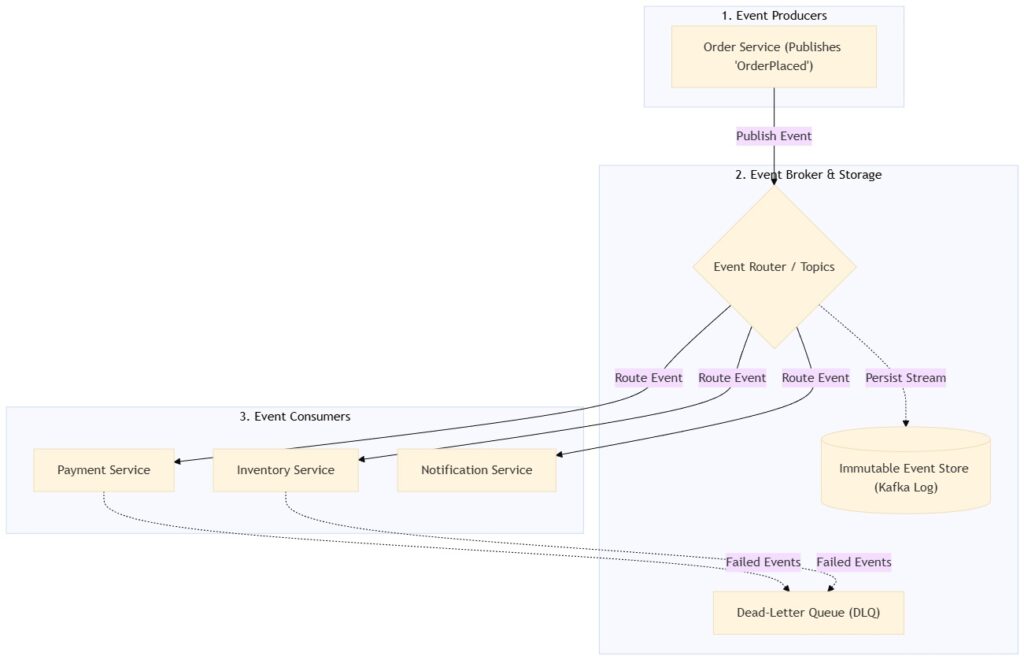
To understand how an event-driven architecture works in practice, think of it as a pipeline where events are produced, routed, consumed, and stored. Each component has a single, distinct responsibility.
- Event Producers: A producer is a component that detects a meaningful state change and publishes an event. For example, when a user buys a product, the Order Service publishes an
OrderPlacedevent. The producer’s job ends the moment the event is published. - Event Brokers: The broker acts as the central nervous system of the architecture. It receives events from producers, filters and routes them, and ensures their reliable delivery.
- Event Consumers: These services subscribe to specific events and perform business actions in response. For instance, a single
OrderPlacedevent might trigger payment processing, inventory updates, shipping workflows, and email confirmations concurrently. - Event Storage: Many platforms store events in immutable logs. This allows teams to replay historical actions, recover from database crashes, and maintain complete audit trails.
Real-World Use Cases and Examples
EDA is a highly versatile architectural style. The following examples highlight how organizations leverage it across different industries:
- E-Commerce Order Processing: When a customer places an order, the system starts a chain of events. The Order Service publishes
OrderPlaced. In response, the Payment Service charges the credit card. Once payment succeeds, it publishesPaymentCompleted, which triggers the Inventory Service to reserve stock and the Shipping Service to create a label. - IoT Platform Monitoring: In an industrial IoT environment, millions of sensors continuously stream temperature and pressure readings. Event-driven systems ingest, process, and analyze these high-volume data streams in real-time, instantly triggering maintenance alerts when values cross safety thresholds.
- Real-Time Notifications: Applications like chat networks, live sports dashboards, and financial trading platforms depend on immediate updates. EDA pushes live events directly to users without requiring resource-heavy, continuous database polling.
- Activity Logging & Auditing: Compliance teams require strict records of system changes. By routing actions (like changing user permissions) as events to a centralized logging consumer, the system creates a secure audit trail without affecting the performance of main databases.
Overcoming the Challenges of Event-Driven Design
Although EDA provides excellent scalability and flexibility, it also shifts system complexity. To build a robust system, you must actively design for the following challenges:
1. Eventual Consistency
Because services communicate asynchronously, data updates do not become visible everywhere at the exact same moment. A consumer might take a few seconds to process an event and update its database.
- Solution: Design business workflows to accept temporary inconsistency. Use design patterns like the Saga Pattern (orchestration or choreography) to coordinate distributed transactions and perform compensating actions if a step fails.
2. Maintaining Event Ordering
In distributed networks, events can arrive out of sequence. For instance, processing a PaymentCompleted event before the corresponding OrderCreated event can place your system into an invalid state.
- Solution: Use partition keys in brokers like Kafka to ensure that related events route to the same partition. Additionally, assign sequence numbers or version identifiers to events so consumers can process them in the correct order.
3. Fault Tolerance and Resilience
If a consumer service crashes or experiences network failure, events can easily get lost or block the entire pipeline.
- Solution: Implement retry mechanisms with exponential backoff. If an event continues to fail after multiple attempts, move it to a Dead-Letter Queue (DLQ) for manual inspection, ensuring that the main processing pipeline remains unblocked.
4. Debugging and Observability
Tracing a request is simple in synchronous systems, but tracking a single business transaction that triggers dozens of events across multiple microservices is highly complex.
- Solution: Generate a unique Correlation ID at the start of a transaction and pass it through all downstream events. Use distributed tracing tools (like OpenTelemetry) and structured, centralized logging to visualize the entire event flow.
Production Best Practices
Follow these four proven best practices to ensure your event-driven system remains reliable and maintainable as traffic grows:
- Build Idempotent Consumers: In distributed networks, duplicate event delivery is a reality, not a bug. Network dropouts and retries can cause brokers to deliver the same event twice. Ensure your consumers are idempotent—meaning processing an event multiple times yields the same state as processing it once. You can achieve this by storing unique event IDs in a database and checking them before executing business logic.
- Isolate Failures with Dead-Letter Queues (DLQs): Never let a malformed event block your main queue. Route failed events to a DLQ so developers can analyze the issue and replay the corrected messages later.
- Choose the Right Broker: Match the broker to your workload. Choose Kafka for high-throughput streaming, event replayability, and analytics. Choose RabbitMQ for complex message routing and traditional queuing. Choose AWS EventBridge for cloud-native integration.
- Plan for Schema Evolution: Event schemas change as business requirements evolve. Design your events with backward compatibility in mind. Use a schema registry (like Confluent Schema Registry with Avro or Protobuf) to validate updates and prevent schema changes from breaking downstream consumers.
Developer FAQ & Interview Preparation
Q1: What is Event-Driven Architecture, and how does it differ from traditional request-response?
Answer: Event-Driven Architecture (EDA) is a design pattern where system components communicate asynchronously through events rather than direct synchronous API calls. In request-response (like REST HTTP), the caller blocks execution and waits for a response. In EDA, the producer publishes an event and immediately continues its work, decoupling the sender and receiver in both time and space.
Q2: What are the main differences between Kafka, RabbitMQ, and AWS EventBridge?
Answer:
- Apache Kafka is an event streaming platform designed for high-throughput log storage, long-term retention, and event replay.
- RabbitMQ is a traditional message broker optimized for complex routing topologies, transient message queuing, and push-based delivery.
- AWS EventBridge is a managed serverless event bus that excels at integrating diverse cloud-native applications and third-party SaaS services.
Q3: How do you handle duplicate event delivery in a distributed system?
Answer: You must design consumers to be idempotent. When a consumer receives an event, it extracts the event’s unique ID and checks a database or cache (e.g., Redis) to see if it has already processed that ID. If the ID exists, the consumer discards the message or returns the previous result without executing the business logic again.
Q4: Why are Dead-Letter Queues (DLQs) crucial in an event-driven system?
Answer: DLQs are crucial because they prevent “poison pill” messages (malformed or invalid events) from blocking your processing pipelines. By automatically routing failed events to a DLQ after a set number of retries, you keep the main queue flowing while capturing the failed events for debugging and manual reprocessing.
Q5: How do you manage schema changes without breaking downstream consumers?
Answer: You manage schema changes by implementing a strict schema evolution strategy. This includes using a Schema Registry, designing schemas with backward compatibility (e.g., adding only optional fields or fields with default values), and including a schema_version header in every event envelope.