

 Ashish Sharma
Why Modern Systems Require Asynchronous Messaging
No money? No problem! Help us pay the cloud hosting bills without opening your wallet—just give
this ad link a click!😉💸
When distributed architectures grow, direct synchronous communication (such as chained REST or gRPC calls) quickly becomes a dangerous bottleneck. If Service A makes an HTTP request to Service B, which synchronously calls Service C and Service D, every component must run flawlessly at the exact same moment.
Consequently, if any downstream service slows down or crashes, the entire call chain collapses. High latency ripples backward, threads block, and overall system throughput plunges.
Synchronous Bottleneck:
[Client] ──> [API Gateway] ──> [Order Service] ──(blocks)──> [Payment Service] ──(blocks)──> [Inventory Service]
Asynchronous messaging eliminates this fragile chain by introducing a durable intermediary buffer—a message broker—between producers and consumers. Instead of waiting for consumers to finish processing, producers simply publish messages and immediately resume other tasks. Consumers then read and process these messages at their own sustainable speed.
By adopting this model, engineering teams achieve three key advantages:
- Loose Coupling: Services communicate through lightweight message contracts rather than network addresses and synchronous endpoints.
- High Resilience: If a consumer crashes or restarts during a deployment, messages stay safely preserved inside the queue rather than vanishing.
- Architectural Flexibility: Teams can introduce new consumers (such as audit logging, push notifications, or real-time analytics) without modifying or retesting the upstream producer.
Fundamental Components of a Messaging System
Although message brokers come in diverse shapes and sizes, every messaging platform relies on five core building blocks:
┌──────────┐    publishes    ┌───────────────────────────┐    consumes     ┌──────────┐
│ Producer │ ──────────────> │       Message Broker      │ ──────────────> │ Consumer │
└──────────┘                 │  [Queue / Topic / Buffer] │ <────────────── └──────────┘
                             └───────────────────────────┘  acknowledges
- Message: The fundamental data payload. It represents an event (e.g.,
OrderPlaced), a command (e.g.,GenerateInvoice), or a discrete business payload serialized as JSON, Protobuf, or Avro. - Producer: The service that constructs and emits the message. Importantly, the producer operates without knowing which downstream services will consume the message or when they will do so.
- Broker: The central traffic manager and storage engine (e.g., RabbitMQ, Apache Kafka, Amazon SQS, Azure Service Bus). The broker receives, verifies, stores, and routes messages through logical channels.
- Channels (Queues vs. Topics): A Queue typically delivers each message to one worker (point-to-point / competing consumers pattern). In contrast, a Topic broadcasts each message to multiple independent subscriber queues (publish-subscribe pattern).
- Consumer: The worker service that subscribes to a queue or topic, executes business logic on incoming messages, and confirms completion.
- Acknowledgement (ACK / NACK): Consumers send an explicit signal back to the broker once processing finishes. A positive acknowledgment (
ACK) tells the broker to remove or commit the message. Conversely, a negative acknowledgment (NACK) prompts the broker to re-queue the message for a retry.
3. Decoupled Architecture: A Real-World Example
To understand decoupling in practice, consider a Product Catalog Service in an e-commerce platform.
Suppose a catalog manager lowers the price of an item. In a legacy synchronous system, the Catalog Service must call the Shopping Cart Service, the Customer Notification Service, and the Search Indexer Service one by one. If the Notification Service fails, the price update might fail or throw an unexpected error.
In an asynchronous, event-driven architecture, the workflow operates independently:
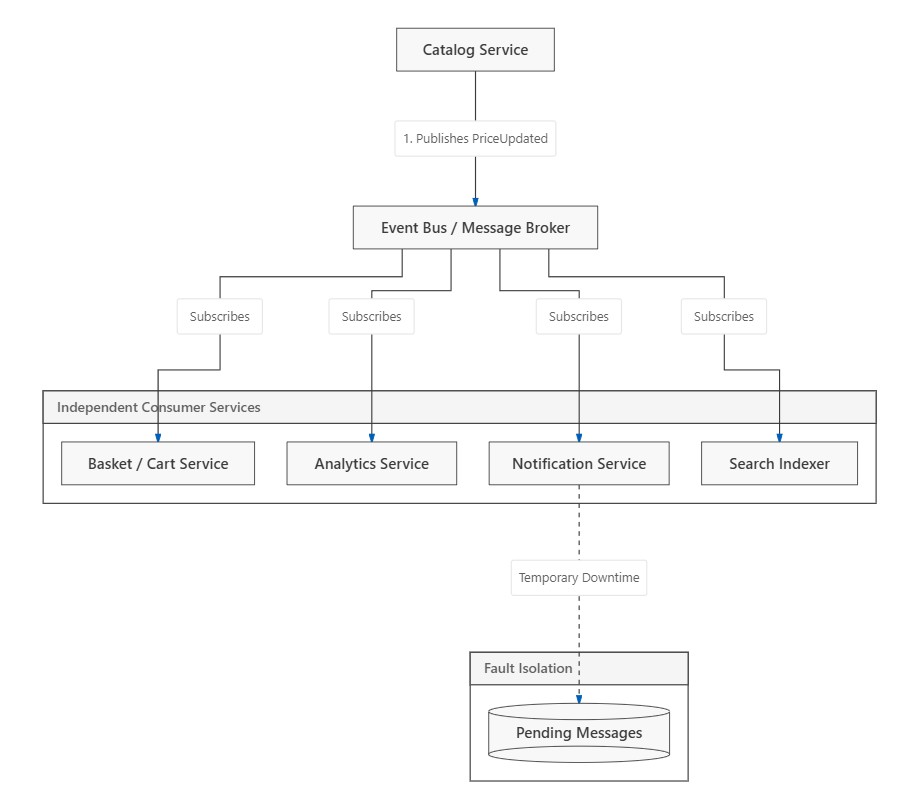
How the Workflow Operates:
- The Catalog Service updates its local database and publishes a
PriceUpdatedevent to the message broker. - The Catalog Service’s responsibility ends immediately; it returns a fast HTTP
200 OKto the administrator. - The Basket Service reads the event and recalculates customer cart totals.
- The Analytics Service records the price drop to track historical demand curves.
- The Notification Service alerts shoppers who saved the item on their wishlists.
If the Notification Service undergoes maintenance or runs into rate limits with an external email provider, the event remains buffered in the broker. The notification service processes those pending alerts immediately upon recovery, ensuring zero message loss and zero disruption to the Catalog Service.
When Should You Use Message Queues?
Message queues should not serve as a blanket replacement for every internal API. Instead, architects should deploy queues to solve specific reliability and scaling problems:
| Trigger Scenario | Why Queues Solve It | Example |
|---|---|---|
| Handling Bursty Traffic | Absorbs massive ingress spikes and lets backends process work at an even, controlled pace. | Flash sales, Black Friday checkouts, or ticket releases. |
| Background Processing | Removes long-running operations from the user’s synchronous web request thread. | PDF generation, video transcoding, bulk CSV imports, and email delivery. |
| Rate-Limited External APIs | Meters request frequency to protect third-party limits and avoid expensive throttling fees. | Sending batches of SMS messages through Twilio or verifying IDs via banking gateways. |
| Decoupling Microservices | Allows distributed teams to build, scale, and deploy autonomous domain services independently. | Splitting monolithic billing and shipping modules into standalone services. |
Architect’s Rule of Thumb: Whenever work can be delayed, retried, or executed without returning an immediate payload to the end user, place that work into a queue.
Message Delivery Guarantees Compared
Distributed systems inevitably experience network blips, server restarts, and container evictions. Therefore, choosing the right message delivery guarantee determines how your application handles failure modes:
At-Most-Once     ───>  Fastest, Zero Retries  ───>  Risk: Message Loss
At-Least-Once    ───>  Retries on Failure     ───>  Risk: Duplicate Messages (Requires Idempotency)
Exactly-Once     ───>  Two-Phase Commits      ───>  Cost: Heavy Latency & Operational Complexity
1. At-Most-Once Delivery
- How It Works: The broker fires the message to the consumer once and immediately deletes it without awaiting confirmation.
- Trade-Offs: Delivers maximum throughput and lowest latency, but risks permanent data loss if the consumer crashes mid-process.
- Best Used For: Non-critical telemetry, metrics gathering, or high-frequency IoT sensor updates where dropping occasional data points does not impact business operations.
2. At-Least-Once Delivery (The Industry Standard)
- How It Works: The broker persists the message until the consumer sends back an explicit
ACK. If the network times out or the worker crashes, the broker redelivers the message. - Trade-Offs: Guarantees zero message loss, but introduces potential message duplication if network acknowledgments drop.
- Best Used For: Order processing, financial updates, and user communications. Must be paired with idempotent consumers.
3. Exactly-Once Delivery
- How It Works: Combines distributed transactions, transactional outboxes, and strict deduplication protocols across both broker and consumer storage engines.
- Trade-Offs: Extremely complex to configure and introduces significant latency overhead.
- Best Used For: High-stakes financial ledger entries and banking transfers where duplicate records cause catastrophic accounting errors.
Technology Comparison: RabbitMQ vs. Apache Kafka
Engineers frequently debate between traditional message brokers and distributed event logs. Both tools excel at decoupling, but they solve fundamentally different problems:
| Dimension | RabbitMQ | Apache Kafka |
|---|---|---|
| Core Architecture | Smart broker, dumb consumer (Queue-based / Push). | Dumb broker, smart consumer (Partitioned Commit Log / Pull). |
| Routing Flexibility | Sophisticated routing keys, topic exchanges, headers, direct queues. | Partition keys send messages to pre-defined topic partitions. |
| Data Retention | Removes messages immediately upon successful consumer ACK. | Persists messages on disk for days/weeks, allowing replaying. |
| Message Ordering | Strict FIFO per individual queue. | Strict order only within a single partition, not across partitions. |
| Typical Use Cases | Complex routing, background tasks, e-commerce transactions, transactional queues. | High-volume event streaming, website clickstreams, real-time metrics, log aggregation. |
Production Best Practices for Message Queues
Deploying message queues without defensive engineering can introduce subtle production bugs. Follow these battle-tested practices to ensure rock-solid stability:

1. Enforce Consumer Idempotency
Because at-least-once systems inevitably send duplicate messages, design consumers to handle redundant executions safely:
- Unique Message Identifiers: Attach an immutable ID (such as
order_idoruuidv4) to every payload. - Deduplication Cache: Store processed IDs in an atomic in-memory cache (like Redis) or a database table before executing work.
- Conditional DB Updates: Write idempotent queries (e.g.,
UPDATE orders SET status = 'PAID' WHERE status = 'PENDING').
2. Isolate Failures with Dead-Letter Queues (DLQ)
A malformed payload (a “poison message”) can crash a worker repeatedly, triggering an endless retry loop that starves system resources. Always configure a Dead-Letter Queue (DLQ). After three to five failed delivery attempts, route the offending message to the DLQ and fire an alert so on-call engineers can inspect it without blocking the pipeline.
3. Implement Exponential Backoff and Jitter
When downstream dependencies (like third-party payment gateways) experience an outage, immediate retries exacerbate the outage. Instead, space out retries exponentially (e.g., retry after 1s, 2s, 4s, 8s, 16s) and add random noise (jitter) to prevent thundering herd problems.
4. Monitor Essential Queue Metrics
Set up dashboards and alerting rules for these operational health indicators:
- Queue Depth (Backlog Size): A steadily rising queue depth reveals that ingestion outpaces consumer capacity.
- Message Age (Consumer Lag): Measures how long messages wait before being picked up.
- Processing Latency: Tracks how many milliseconds individual consumers take to process a job.
5. Secure the Broker
Message brokers carry sensitive business payloads. Enforce strict TLS in-transit encryption, encrypt data volumes at rest, restrict network access with VPC subnets, and mandate per-service authentication via SASL or mTLS.
Common Use-Case Scenarios
Scenario A: Asynchronous Order Fulfillment Pipeline
In a modern shopping platform, when a buyer clicks “Purchase”:
- The Checkout Service captures the card payment and writes an
OrderPlacedevent to the broker. - The user sees an immediate order confirmation screen.
- Simultaneously, three separate worker pools pull from the queue:
- Inventory Workers reserve stock items in the warehouse.
- Shipping Workers generate tracking labels via carrier APIs.
- Email Workers dispatch customer receipts.
Scenario B: Traffic Shaping and Load Leveling
During promotional campaigns, thousands of concurrent users submit feedback or click tracking pixels simultaneously. Rather than spinning up dozens of expensive database instances to absorb the write spike, the web tier dumps events into a message queue. A modest pool of background workers drains the queue continuously, transforming a spiky wave into a flat, manageable line of database writes.
Scenario C: Centralized Logging and Telemetry
Instead of services writing log entries directly to an ElasticSearch or OpenSearch cluster over HTTP, services output structured JSON to Kafka or RabbitMQ. A dedicated log-ingestion pipeline reads messages in batches, normalizes fields, and writes bulk inserts to the search engine, shielding production services from logging cluster latency.
Interview Cheat Sheet: Messaging & Queues
Q1: Why would you use asynchronous messaging in a system?
Answer: Asynchronous messaging decouples senders and receivers, allowing them to operate independently. This improves:
Scalability: Producers do not block waiting for consumers to finish.
Resilience: If downstream services slow down or fail, messages stay safely buffered.
User Experience: Speeds up user response times by offloading slow tasks (e.g., sending emails, generating reports).
Maintainability: Services evolve and scale autonomously without tight API couplings.
Q2: What are the primary differences between RabbitMQ and Apache Kafka?
Answer: RabbitMQ is a traditional message broker built around queues and smart routing. It pushes messages to consumers and deletes them once acknowledged, making it ideal for discrete, transactional task processing. In contrast, Kafka is an append-only distributed commit log. Consumers pull data at their own pace, and messages remain stored for a configurable retention window, making Kafka the top choice for high-throughput event streaming and analytics replay.
Q3: How do the three delivery guarantees differ, and where do you apply them?
Answer:
At-most-once: Delivers messages without retries. It guarantees speed but risks data loss; ideal for non-critical telemetry and logs.
At-least-once: Retries failed messages until acknowledged. It guarantees zero data loss but may introduce duplicates; ideal for standard e-commerce orders, payments, and notifications (when combined with idempotent consumers).
Exactly-once: Guarantees no message loss and no duplicates via distributed coordination. It introduces high complexity and latency; reserved for critical financial ledgers and bank balance updates.
Q4: How do queues improve fault tolerance during major traffic spikes?
Answer: Queues act as an elastic buffer (load leveling). During sudden surges (such as Black Friday sales), producers push messages onto the queue without overwhelming backend databases. Downstream consumers pull work at a steady, sustainable pace. If a consumer crashes, the broker retains the messages until a healthy worker claims them.
Q5: What problems arise in a queue-based system under heavy load, and how do you mitigate them?
Answer:
Problems: Massive queue backlogs, prolonged latency (message lag), memory exhaustion on the broker, and cascading duplicate processing if consumers time out before acknowledging.
Mitigations: Auto-scale consumer instances horizontally, optimize worker throughput, configure Dead-Letter Queues (DLQ) to isolate poison pills, and apply backpressure to throttle incoming traffic at the edge.
Q6: How would you architect an order processing workflow with message queues?
Answer:
The client places an order; the API Gateway validates input, writes an order record to the local DB, and publishes an OrderCreated message to an exchange/topic.
The API immediately returns an order tracking ID to the customer.
The broker routes copies of the event to individual queues: Payment Queue, Inventory Queue, and Notification Queue.
Dedicated consumer pools process each queue independently. If payment succeeds, an event chains the next action; if a transient network failure occurs, the consumer retries with exponential backoff.
Q7: How do you guarantee idempotency in message consumers?
Answer:
Assign every message a globally unique idempotency key (e.g., event_id or order_id).
Check an atomic, fast key-value store (such as Redis) or a database table (processed_messages) before executing work.
Execute the operation inside a database transaction alongside the recorded message ID, or write update statements using optimistic locking and conditional guards (e.g., WHERE status = 'PENDING').
Summary & Key Takeaways
Asynchronous messaging forms the foundation of modern, scalable distributed systems. By replacing tight, synchronous RPC chains with durable message brokers:
- Systems decouple: Producers and consumers evolve, deploy, and scale independently.
- Traffic smooths out: Message queues absorb abrupt traffic spikes and protect downstream resources.
- Failures isolate gracefully: If downstream workers crash, messages remain safe inside the broker for later processing.
- At-least-once delivery + Idempotency provides the optimal balance of speed, resilience, and operational simplicity for nearly all enterprise applications.