

 Ashish Sharma
Introduction: Why Modern Scalability Demands Smart Task Coordination
No money? No problem! Help us pay the cloud hosting bills without opening your wallet—just give
this ad link a click!😉💸
Modern applications rarely struggle because hardware lacks power; rather, applications struggle because software wastes system resources. When users flood an application with thousands of concurrent requests, servers can either handle the surge gracefully or crash under resource exhaustion.
Architects achieve true scalability by understanding two foundational strategies: concurrency and parallelism. Although engineers frequently use these terms interchangeably, each solves a distinct architectural problem:
- Concurrency is about managing multiple tasks at once. The system coordinates several tasks by interleaving their execution, even on a single CPU core. As a result, the application remains responsive while waiting for external dependencies.
- Parallelism is about executing multiple tasks simultaneously across multiple CPU cores. The system actively splits heavy computational workloads to maximize throughput and speed.
Rule of Thumb: Concurrency deals with many things at once (task coordination). Parallelism does many things at once (simultaneous execution).
Architectural Diagram: Concurrency vs. Parallelism
To visualize this core distinction, observe how tasks navigate CPU resources:
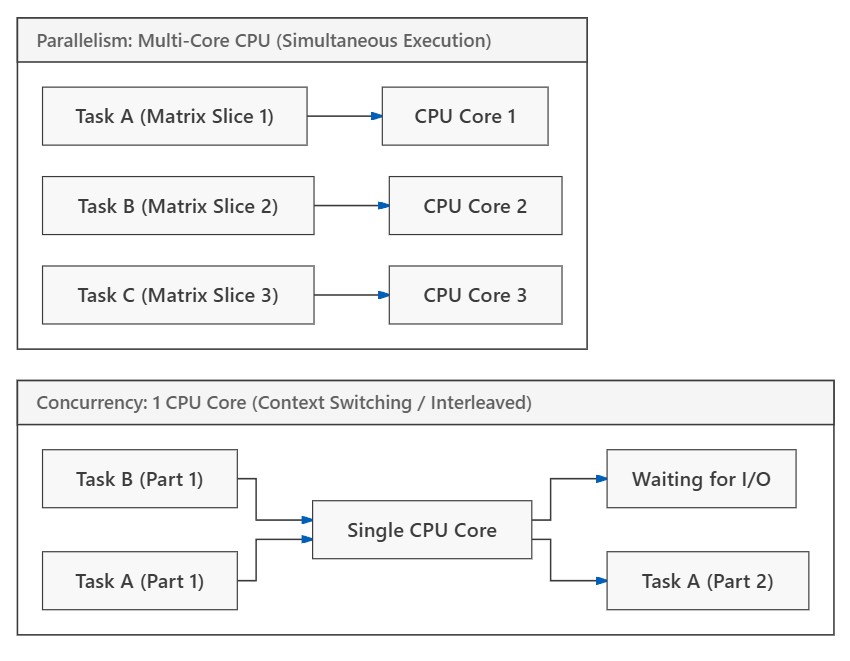
Consequently, single-core devices (like microcontrollers) can run concurrent applications smoothly, but they cannot achieve true parallelism without additional hardware cores.
Processes vs. Threads: The Trade-Off Between Isolation and Efficiency
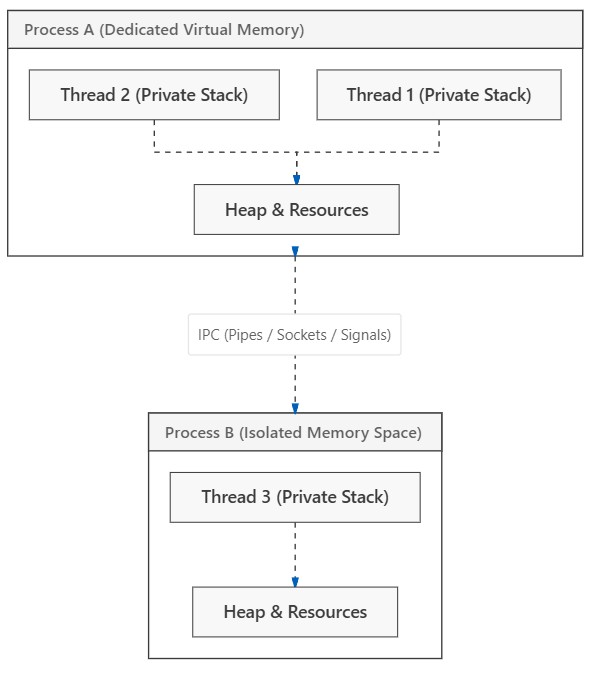
Operating systems organize execution into two fundamental units: processes and threads. Selecting between them requires balancing fault isolation against memory and runtime overhead.
Processes: Maximum Isolation and Resilience
A process represents an independent, self-contained application instance. The operating system assigns each process a private address space, environment handles, and system resources.
- Advantage: Strong fault boundaries. If a worker process encounters a catastrophic memory error or crashes, the operating system isolates and terminates it without disrupting other processes.
- Drawback: High resource overhead. Creating a new process demands significant memory allocation, and context switching between processes requires costly TLB (Translation Lookaside Buffer) flushes.
- Typical Use Cases: Web browser tabs (Chrome sandbox), database engines (PostgreSQL worker processes), and microservices.
Threads: High Performance and Shared State
A thread is the smallest unit of execution within a parent process. All threads inside a given process share that process’s virtual memory space, heap, and open file descriptors.
- Advantage: Ultra-fast context switching and low memory footprint. Because threads share state natively, inter-thread communication requires no complex serialization protocols.
- Drawback: Vulnerability to race conditions and corruption. A single uncaught exception or memory overwrite in one thread can crash the entire host process.
- Typical Use Cases: Web server request pipelines (ASP.NET Core, Java Tomcat), real-time game physics, and in-memory caching systems.
| Feature | Process | Thread |
|---|---|---|
| Memory Space | Isolated private memory | Shared memory within host process |
| Creation Cost | High (allocates new address space) | Very low (allocates private stack only) |
| Context Switch Overhead | Heavy (switches page tables, flushes cache) | Fast (preserves page mappings) |
| Communication | Inter-Process Communication (IPC, Sockets) | Direct memory access (Pointers, References) |
| Fault Boundary | High (one process crash does not affect others) | Low (one thread crash can take down process) |
Thread Pools and Worker Models: Optimizing Workload Distribution
Frequently creating and destroying threads introduces severe latency. Every raw thread allocation forces the operating system to reserve stack space (typically 1MB per thread), register scheduler handles, and deallocate memory upon completion. Under heavy traffic, uncontrolled thread spawning degrades system performance through CPU thrashing.
The Solution: Reusable Thread Pools
Modern execution environments maintain a pre-allocated pool of worker threads. Rather than initializing a new thread for each incoming unit of work, the application submits the task to a thread pool:
- A client initiates a task.
- The runtime grabs an idle thread from the pool.
- The assigned thread executes the task.
- Finally, the thread returns to the pool, ready for the next request.
The Worker Model: Decoupling Task Creation from Execution
Thread pools work hand-in-hand with the Worker Model. Instead of tightly coupling tasks to specific execution threads, developers place incoming jobs into a synchronized FIFO (First-In, First-Out) work queue. Multiple background workers continuously pull and process work from this queue.
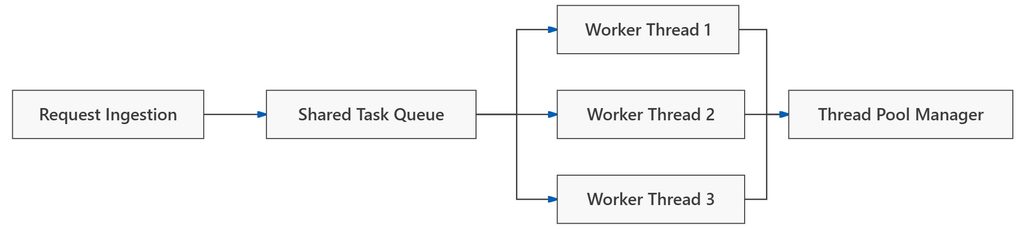
Furthermore, this decoupled worker pattern provides dynamic load balancing, absorbs traffic spikes, and prevents threads from exceeding system memory limits.
Asynchronous Processing: Eliminating CPU Idle Time
The single biggest performance killer in modern distributed applications is waiting. Applications spend the majority of their lifecycle waiting for relational databases, remote REST APIs, microservices, and file storage systems to reply.
Blocking Model:      [CPU: 5ms] ---> [WAITING ON DATABASE: 95ms (Thread Idle)] ---> [CPU: 5ms]
Non-Blocking Model:  [CPU: 5ms] ---> Thread released to handle Request B!
                                     (Database completes -> Callback notifies pool)
                                     [CPU resumes Request A: 5ms]
When a synchronous thread executes a database query, it remains blocked and idle for the entire network round trip. In contrast, asynchronous processing releases the active thread immediately after dispatching the network I/O request. The thread returns to the pool to process other user actions. Once the database returns data, the operating system signals the runtime, which grabs an available thread to resume code execution.
Architectural Implementations
- Language-Level Primitives (
async/await, Promises, Futures):
Modern programming languages (C#, TypeScript, Python, Rust) turn complex non-blocking callbacks into clean, sequential-looking code. They register lightweight continuations without pinning physical threads. - Distributed Message Queues (RabbitMQ, Apache Kafka, AWS SQS):
When processing operations that take several seconds or minutes (e.g., video rendering, bulk PDF generation, sending customer emails), systems offload tasks from web servers entirely. The web service pushes a message to a broker, responds instantly to the client with202 Accepted, and allows worker clusters to process jobs in the background.
End-to-End System Architecture: The Modern Non-Blocking Web Server
Traditional web servers allocated one dedicated thread per connection. Under ten thousand active connections, these servers consumed gigabytes of RAM and spent more time switching thread contexts than executing business logic.
Modern architectures resolve this bottleneck using event loops and non-blocking I/O multiplexers (such as Linux epoll or Windows IOCP).
The following architectural diagram illustrates how high-throughput systems coordinate client traffic, asynchronous web gateways, thread pools, and distributed message queues:
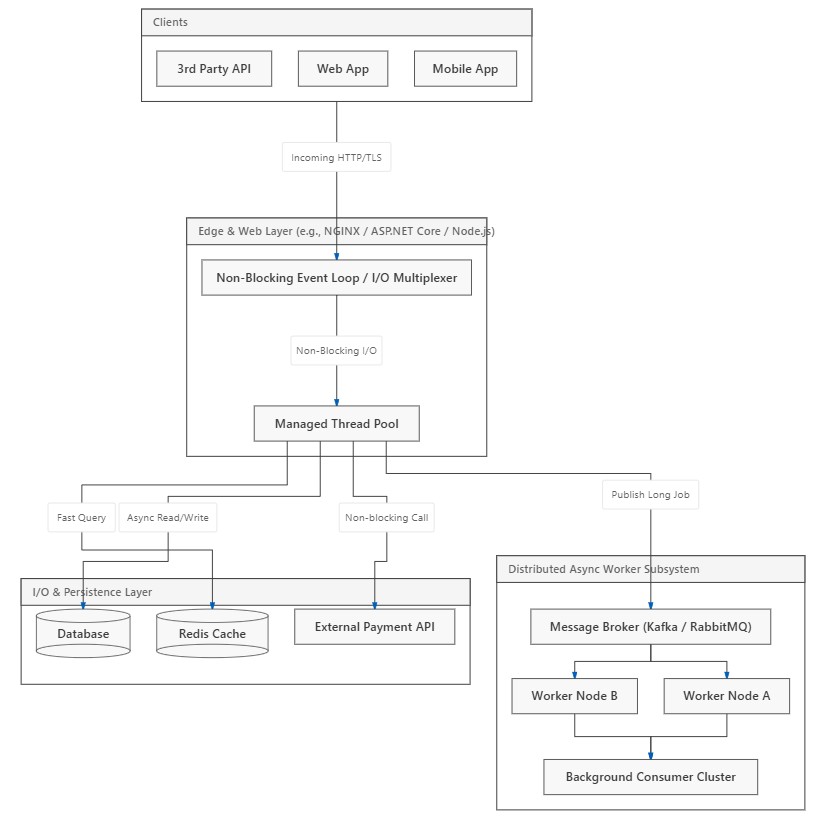
How Major Platforms Implement This Architecture
- Node.js: Executes JavaScript on a single-threaded event loop while offloading blocking file or crypto operations to an underlying C-based
libuvworker pool. - ASP.NET Core: Employs an optimized I/O ThreadPool alongside an asynchronous request pipeline, allowing a modest number of cores to service tens of thousands of active connections.
- NGINX: Employs an event-driven master-worker process architecture that multiplexes thousands of incoming connections onto a single worker process without thread allocation overhead.
Common Concurrency Pitfalls and How to Prevent Them
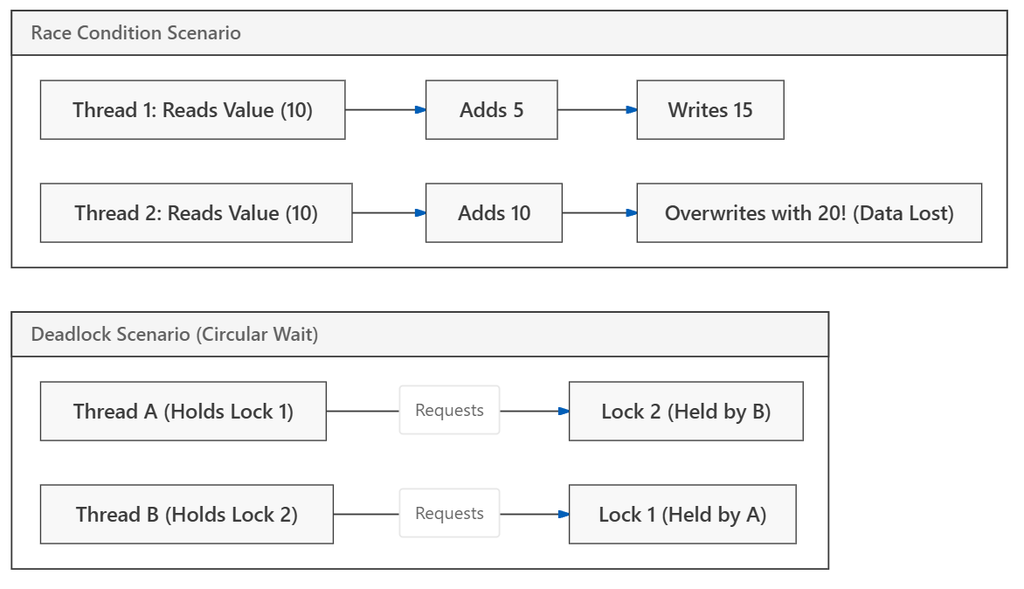
While concurrency unlocks extreme throughput, it also introduces bugs that can escape standard unit testing and trigger unpredictable production outages.
1. Race Conditions
- The Problem: Two or more threads read and write to the same shared memory address simultaneously. The final state depends on arbitrary OS thread scheduling.
- The Solution:
- Utilize atomic operations (e.g.,
Interlocked.Incrementin C# orAtomicIntegerin Java) for simple numeric counters. - Apply mutual exclusion locks (
Mutex,SemaphoreSlim, orlockstatements) around critical sections. - Prefer immutable data structures and purely functional state updates to eliminate in-place mutations.
- Utilize atomic operations (e.g.,
2. Deadlocks
- The Problem: Thread A holds Resource 1 and requests Resource 2. Meanwhile, Thread B holds Resource 2 and requests Resource 1. Neither thread can proceed, freezing the application indefinitely.
- The Solution:
- Global Acquisition Ordering: Always acquire nested locks in the identical hierarchical sequence across the entire codebase.
- Lock Timeouts: Never wait indefinitely. Use timeout-enabled acquisition methods (e.g.,
Monitor.TryEnterorstd::unique_lock::try_lock_for). - Lock-Free Collections: Replace manual lock blocks with thread-safe collections (e.g.,
ConcurrentDictionary,ConcurrentQueue).
Real-World Use-Case Scenarios
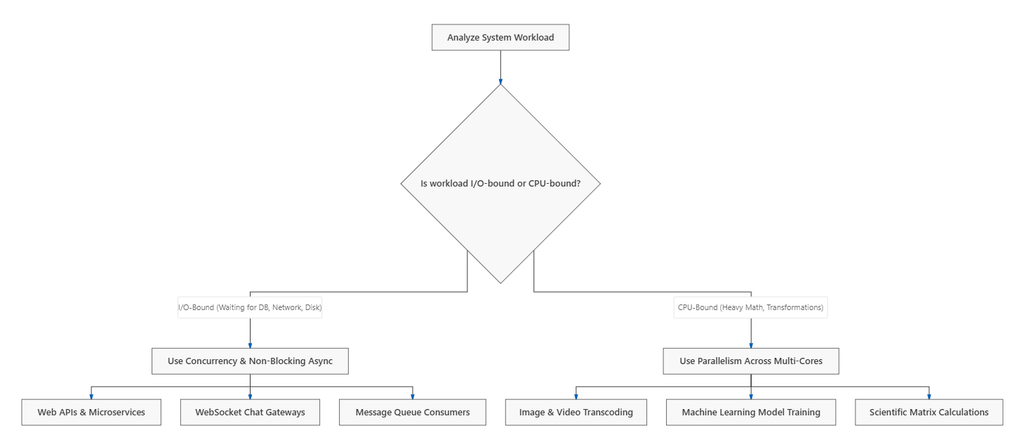
To select the correct strategy, analyze whether your application is I/O-bound or CPU-bound:
Scenario A: High-Traffic Fintech Payment Gateway (I/O-Bound)
- Problem: The payment service must handle 50,000 incoming requests per minute. Each transaction must verify user tokens, call external fraud APIs, and update a distributed SQL database.
- Optimal Choice: Asynchronous Concurrency.
- Implementation: Engineers configure non-blocking HTTP clients and async/await database drivers. Threads never block while waiting for external bank responses. Consequently, a lean cluster of small container instances easily manages the traffic without exhausting memory.
Scenario B: Medical Imaging & 3D Tumor Reconstruction (CPU-Bound)
- Problem: A healthcare platform receives 2GB DICOM scan files and must reconstruct dense 3D voxel models within seconds.
- Optimal Choice: Multi-Core Parallelism.
- Implementation: The service leverages the Fork/Join pattern. It segments the high-resolution voxel matrix across all 32 CPU cores of a compute instance. Each core processes its designated chunk concurrently, reducing total computation time from minutes to seconds.
Scenario C: E-Commerce Order Confirmation & Notification (Decoupled Background Work)
- Problem: During flash sales, checkout must complete under 200ms, but the application must also generate invoices, charge rewards points, and dispatch emails.
- Optimal Choice: Worker Model with Message Queue.
- Implementation: The checkout web request saves the order, pushes an
OrderPlacedevent to Apache Kafka, and completes immediately. Independent worker pools read the Kafka topic asynchronously, generating PDF invoices and sending emails at their own sustainable pace.
Summary and Architectural Takeaways
- Design for Workload Characteristics: Adopt non-blocking asynchronous I/O for network- and storage-bound applications; employ multi-core parallelism for computational, CPU-heavy tasks.
- Reuse Resources: Avoid creating raw threads on demand. Rely on thread pools to throttle resource utilization and implement worker queues to distribute tasks cleanly.
- Prioritize System Correctness: Fast systems are useless if they corrupt records. Minimize shared mutable memory, favor immutability, and apply timeouts to prevent lock-induced deadlocks.
- Scale Beyond In-Memory Work: When operations take noticeable time, decouple them with distributed message queues (e.g., Kafka, RabbitMQ) to guarantee high availability and resilience under traffic spikes.